ULTY stock is the phrase most people type, but ULTY is not a company share. It is the ticker for the YieldMax Ultra Option Income Strategy ETF, an actively managed fund listed on NYSE Arca. It launched on February 28, 2024, and is run by Tidal Investments under the YieldMax brand.
Its pitch is simple: very high weekly cash payouts, funded mainly by selling options on volatile stocks. The trade-off is just as simple: the share price has fallen sharply, and a large part of recent payouts has been classed as return of capital.
Key Takeaways
- ULTY is an ETF, not a single stock, and it holds roughly 15 to 30 underlying securities.
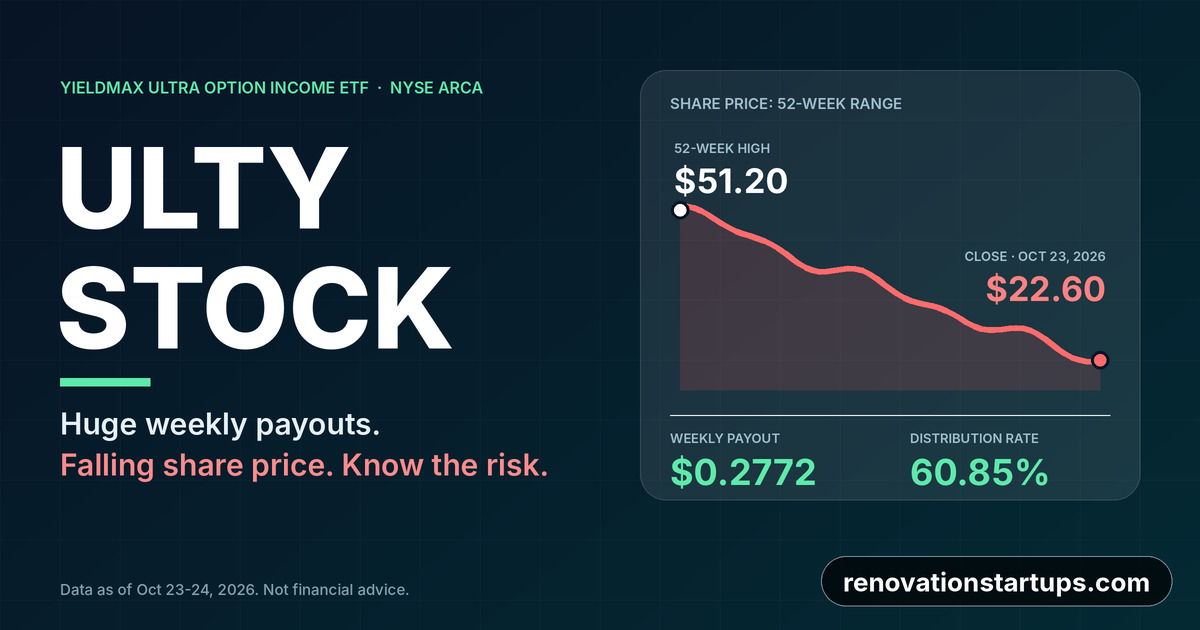
- It pays weekly. The distribution declared for October 21, 2026 was $0.2772 per share, an annualized distribution rate of about 60.85%.
- That same distribution is estimated to be 100% return of capital, and the fund’s 30-day SEC yield is negative (about -0.75%).
- The share price closed near $22.60 on October 23, 2026, against a 52-week range of roughly $22.51 to $51.20.
- The net expense ratio is 1.30% (1.40% gross, after a 0.10% waiver).
- It suits informed investors who want cash flow and accept losing principal. It is a poor fit as a core long-term holding.
What Is ULTY?
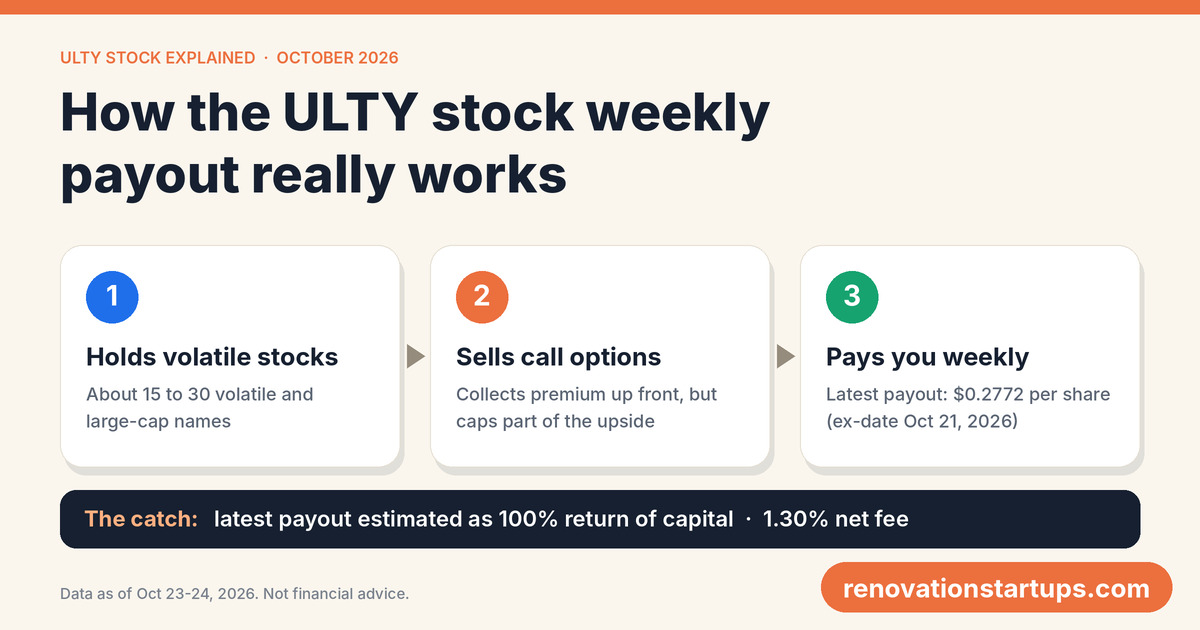
ULTY is built to turn market volatility into income. Instead of simply owning a stock index, the fund holds a rotating basket of high-volatility companies and pairs them with option strategies. According to the issuer, it invests across about 15 to 30 securities, mixing very volatile names that generate large option premiums with steadier large caps meant to anchor the portfolio.
The fund also describes using call spread strategies. In plain terms, it sells call options (collecting cash up front) and buys other calls to limit risk. The cash collected funds distributions to shareholders.
How ULTY’s Weekly Income Works
- The fund holds or gains exposure to volatile stocks. Recent top holdings reported by a major fund-research firm included large technology and growth names, plus a gold miners ETF.
- It sells call options on them. Buyers pay a premium for the right to profit if the stock rises above a set price.
- The premium becomes distributable cash. More volatility usually means bigger premiums.
- Upside is capped. If a stock surges past the option’s strike price, the fund does not capture all of that gain.
- Payouts go out weekly. The fund moved to weekly distributions in March 2025, partly to reduce the NAV damage linked to payout timing.
ULTY Distribution and Yield What the Numbers Say
| Metric | Latest figure | Notes |
| Latest weekly payout | $0.2772 per share | Ex-date October 21, 2026, paid October 22 |
| Distribution rate | About 60.85% | Annualizes the latest payout against NAV |
| 30-day SEC yield | About -0.75% | Measures net investment income, excluding option income |
| Estimated return of capital | 100% (latest distribution) | Estimate; final tax character is set later |
| Net expense ratio | 1.30% | Gross 1.40% before waiver |
| Typical bid-ask spread | About 0.04% (30-day median) | Cheap to trade |
Why do yield figures differ between websites? Some sites show the forward rate (latest payout annualized, around 60%). Others show the trailing 12-month yield, which can look far higher (figures in the 70% to 90% range appear) because the share price has fallen while earlier payouts were larger. Neither number tells you your return. Total return does.
ULTY Share Price and Performance
- Price: closed at $22.60 on October 23, 2026, near the bottom of its 52-week range.
- Assets: about $650 million to $700 million, depending on the data provider and date.
- Total return: one data provider reported a total return of about -9% over the past year including dividends. Another calculated that $10,000 invested at launch in February 2024 and fully reinvested would be worth roughly $11,300 by early October 2026.
- Rating: Morningstar assigns a quantitative Neutral Medalist Rating (rated August 31, 2026).
Reinvested distributions have kept the long-run total return slightly positive, but the share price itself has dropped heavily. That gap is the heart of the ULTY debate.
The Main Risks of ULTY
1. NAV erosion
When a fund pays out more than it earns, the difference comes from its own assets, so net asset value falls. Independent analysts have reported a NAV decline of more than 50% over a recent 12-month window, consistent with the 52-week price range above.
2. Return of capital is not free income
Return of capital is a tax classification, and the issuer notes it is not necessarily an economic loss. Even so, a fund cannot keep paying out more than it generates without shrinking. Return of capital also lowers your cost base for tax purposes (see the Canada section).
3. Capped upside
Selling calls limits participation in big rallies, while you still carry most of the downside of the stocks held.
4. Concentrated, volatile holdings
The income engine depends on speculative, high-volatility stocks. In a sharp sell-off, losses can outrun the cash you collect.
5. Unpredictable payouts
The issuer has itself warned that future distribution levels may be less predictable. Weekly amounts have already fallen from around $0.50 per share in January 2026 to under $0.30 in October 2026.
6. High fees
A 1.30% net expense ratio is well above plain index ETFs.
Who Might Consider ULTY (and Who Should Not)
Possible fit investors who understand options, want maximum near-term cash flow, treat it as a small satellite position, and can accept the price drifting lower.
Poor fit: anyone seeking steady long-term growth, capital preservation, or reliable retirement income, or anyone attracted only by the headline yield.
ULTY for Canadian Investors
ULTY trades on a US exchange, in US dollars. I did not find a Canadian-listed version of this specific fund, so Canadians would typically buy it through a brokerage account that supports US-listed securities. Points to check:
- US withholding tax: US-listed ETFs paying Canadian investors are generally subject to a 15% US withholding tax on dividends under the tax treaty, although holding certain US-listed ETFs inside an RRSP or similar retirement account is generally exempt. Withholding is generally not recoverable inside a TFSA. How this applies to a fund whose payouts are classed as return of capital can be complicated, so confirm with your broker or a tax professional.
- Return of capital and adjusted cost base (ACB): return-of-capital distributions generally reduce your ACB, which can mean a larger capital gain later when you sell.
- Currency: converting CAD to USD adds cost and exchange-rate risk, which can offset or magnify returns.
- Account choice: the RRSP, TFSA and taxable account each treat this differently.
This is general information, not tax advice. Speak to a qualified Canadian tax advisor.
How to Evaluate ULTY Before Buying
- Compare the fund’s NAV to the total distributions you would have received since a given purchase date.
- Look at total return, not yield.
- Read the latest distribution notice for the return-of-capital estimate.
- Check holdings concentration and how much one or two names dominate.
- Size the position small enough that a large drawdown would not hurt your plans.
Final Verdict
ULTY delivers what it advertises: large weekly cash payments. It also delivers what critics warn about: a share price that has fallen steeply and distributions that are largely return of capital. Treat it as a high-risk, income-focused tool, judge it by total return rather than yield, and keep any position modest.
Frequently Asked Questions
Is ULTY a stock or an ETF?
It is an actively managed ETF, though many people search for it as “ULTY stock.”
How often does ULTY pay?
Weekly, with announcements typically on Tuesdays.
Is ULTY’s dividend safe?
Not in the sense of being guaranteed. Payout amounts have declined over time and depend on option premiums and market conditions.
Does ULTY pay qualified dividends?
Its recent distributions are being estimated as return of capital. The final tax classification is determined after year-end, so check your tax slip.
What is a good alternative?
Other option-income funds exist, but they carry similar trade-offs. Broad dividend-growth or index funds usually offer lower yield with less principal risk.
Can I lose money in ULTY?
Yes. Both the share price and the payouts can fall.
