
Picture a cardiac arrest on a hospital ward. Dozens of decisions need to happen in minutes. How does a team keep them straight? The ACLS algorithm is a set of flowcharts that tells trained responders what to check, what to treat and when to repeat, covering cardiac arrest, dangerously slow heartbeats and dangerously fast ones. It builds on basic life support and is used by physicians, nurses, paramedics and respiratory therapists in Canada and the USA.
How Does the ACLS Algorithm Work During Cardiac Arrest?
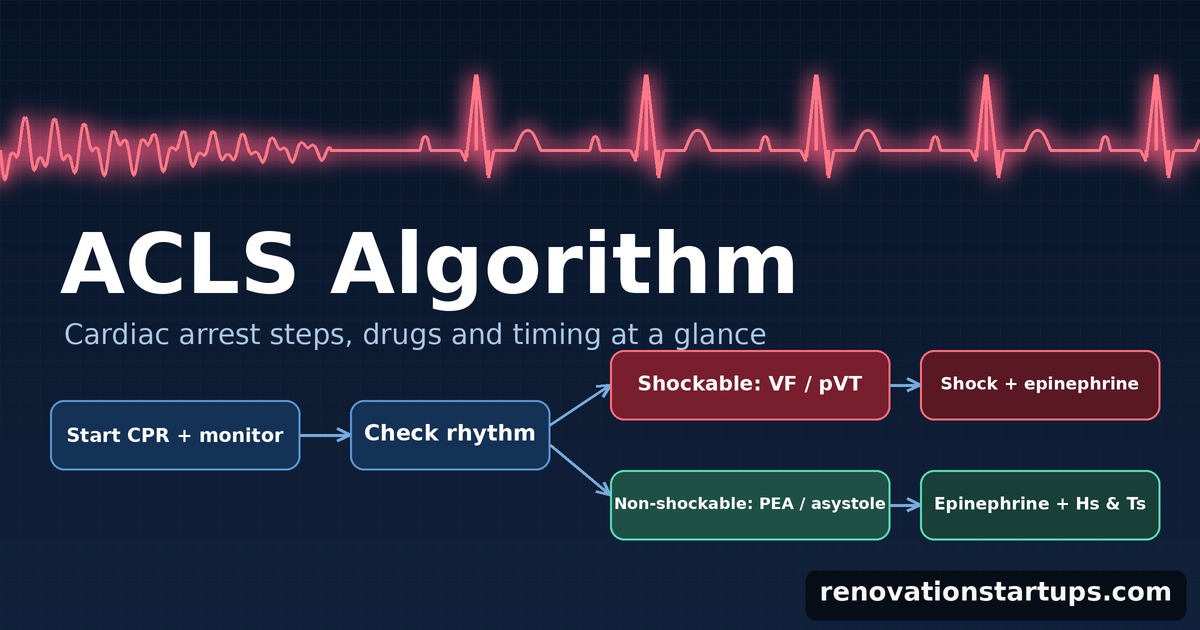
I’ll start here because this is the pathway most people mean when they say “running a code.” The ACLS algorithm for cardiac arrest splits into two branches, and everything depends on one early question: is the rhythm shockable?
The team starts high-quality CPR, attaches a monitor or defibrillator, and reads the rhythm. Compressions go at 100 to 120 per minute, at least 5 cm deep, with full chest recoil. Switch the compressor about every two minutes, because fatigue quietly ruins quality. In my experience, that handover is where teams most often lose seconds.
Shockable Rhythms: Ventricular Fibrillation and Pulseless Ventricular Tachycardia
If the monitor shows ventricular fibrillation or pulseless ventricular tachycardia, the team delivers a shock and resumes CPR straight away, without pausing to check a pulse. After the second shock, epinephrine 1 mg IV or IO is given and repeated every 3 to 5 minutes. If the rhythm persists after the third shock, amiodarone 300 mg is the usual first antiarrhythmic, followed by 150 mg if needed. Lidocaine is an accepted alternative.
Non-Shockable Rhythms: Asystole and Pulseless Electrical Activity
Here a shock does nothing, so the focus shifts. Epinephrine goes in as early as possible, CPR continues in two-minute cycles, and the team hunts for a cause. Clinicians use the “Hs and Ts” memory aid for this: low oxygen, low volume, acid buildup, potassium problems, temperature extremes, then tension pneumothorax, tamponade, toxins and clots in the lungs or coronary arteries. Many of these are fixable, so finding the cause often matters more than any single drug.
What Do the Bradycardia and Tachycardia Pathways Look Like?
Not every ACLS patient has arrested. Some still have a pulse but an unstable rhythm, and the algorithm has separate charts for them. The first thing to settle is whether the patient is stable or unstable. Signs of instability include low blood pressure, chest pain, altered mental status and signs of shock.
Bradycardia With a Pulse
For a slow heart rate causing symptoms, the ACLS algorithm for bradycardia begins with airway support, oxygen if needed, and a monitor. Atropine 1 mg IV is the first drug, repeatable every 3 to 5 minutes to a maximum of 3 mg. If that fails, options include transcutaneous pacing, a dopamine infusion at 5 to 20 mcg/kg/min, or an epinephrine infusion. Atropine tends to work poorly in some high-degree heart blocks, which is why pacing pads are often applied early.
Tachycardia With a Pulse
Fast rhythms follow the same stable-versus-unstable logic. An unstable patient gets synchronized cardioversion, not an unsynchronized shock, and the distinction matters. A stable patient with a regular narrow-complex rhythm may first try vagal manoeuvres, then adenosine 6 mg by rapid IV push, followed by 12 mg if the first dose fails. A stable patient with a wide-complex rhythm needs more careful thought, and expert consultation is reasonable.
Did you notice the pattern? Every branch asks the same thing: is this person stable?
What Happens After the Heart Restarts?
Getting a pulse back is only the midpoint. Post-cardiac arrest care aims to protect the brain and heart. Teams generally aim for oxygen saturation of 92 to 98 per cent, avoid low blood pressure, obtain a 12-lead ECG quickly, and consider emergency coronary angiography when the ECG suggests a blocked artery. Temperature control is also standard, keeping the patient at a steady temperature rather than allowing fever. Hospitals typically move these patients to an intensive care unit or cardiac centre, such as those in Toronto, Calgary or Vancouver.
How Do Canadian and American Guidelines Compare?
Here is a question I hear often: do the two countries follow different rules? Mostly, no. Both rely on the same international evidence review, so the core ACLS algorithm looks nearly identical on both sides of the border. In Canada, the Heart and Stroke Foundation publishes the guidelines, while in the USA the American Heart Association does. Differences show up in the details, such as drug availability, provincial or state scopes of practice for paramedics, and local protocols about who may give which medication.
One practical point: dosing in Canadian hospitals is in metric units, and we use mmol/L rather than mg/dL for lab values like potassium and glucose. If you work across the border, double-check the units before acting on a result. Guidelines are also updated periodically, so always confirm the current version through your certifying body instead of relying on any article, including this one.
Final Thoughts
Think of the ACLS algorithm as a shared language for chaotic moments. It does not replace judgment, but it gives a team a common map so everyone moves the same way. If you work in healthcare, I’d encourage you to rehearse it regularly with your team.
FAQ
How often do you need to renew ACLS certification?
Most certifications last two years. Many employers expect renewal before expiry, and some hospitals ask for a refresher sooner for emergency, critical care or anesthesia staff.
Is the ACLS algorithm hard to learn?
It feels heavy at first, but it follows a logic. Once you understand the shockable versus non-shockable split and the stable versus unstable question, the rest is repetition. Practising with a mock code and a real defibrillator helps far more than memorizing the charts.
What is the difference between BLS and ACLS?
Basic life support covers CPR, early defibrillation and airway basics, and anyone can learn it. ACLS adds drugs, advanced airways, rhythm interpretation and team leadership, and it is meant for trained healthcare providers.
Can a layperson use these flowcharts?
Not directly. Members of the public should call 911, start compressions, and use an automated external defibrillator if one is nearby. The advanced steps above are for professionals working under medical authority.
