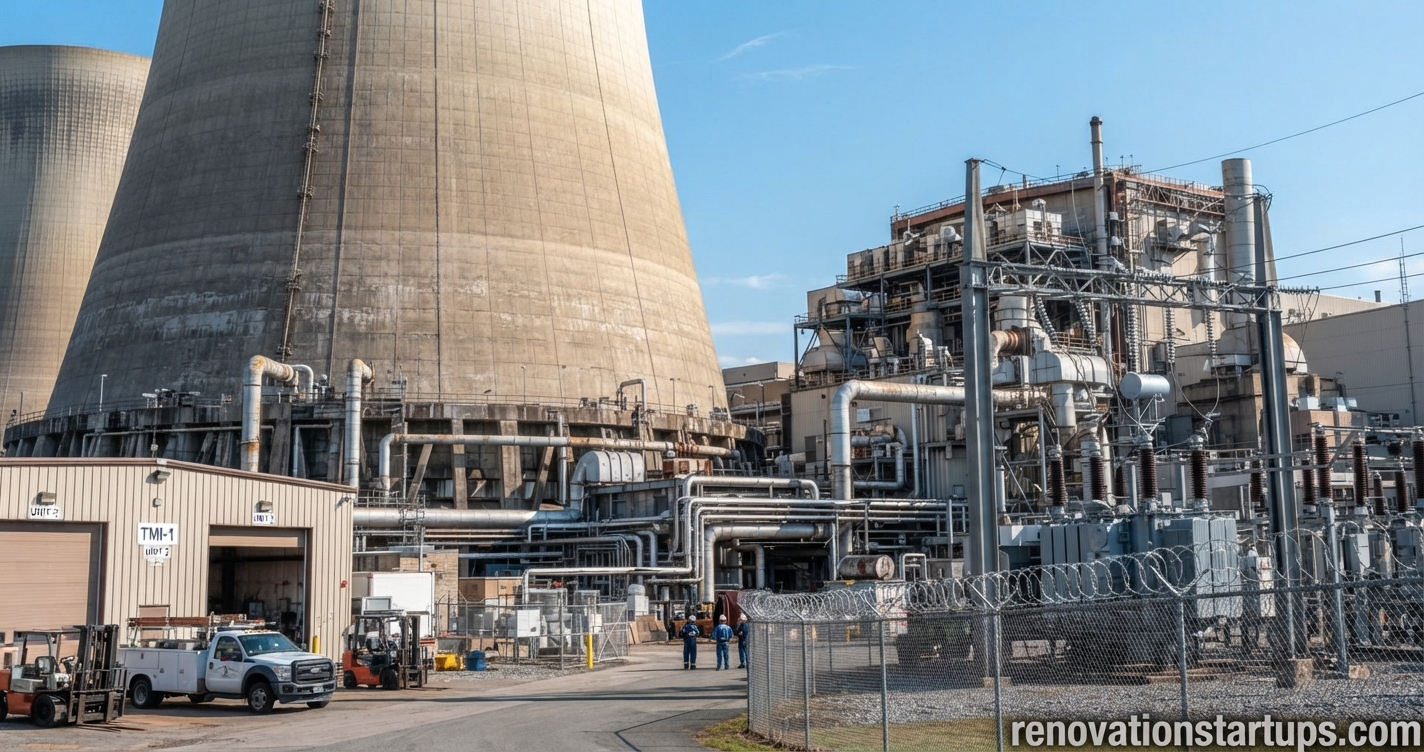
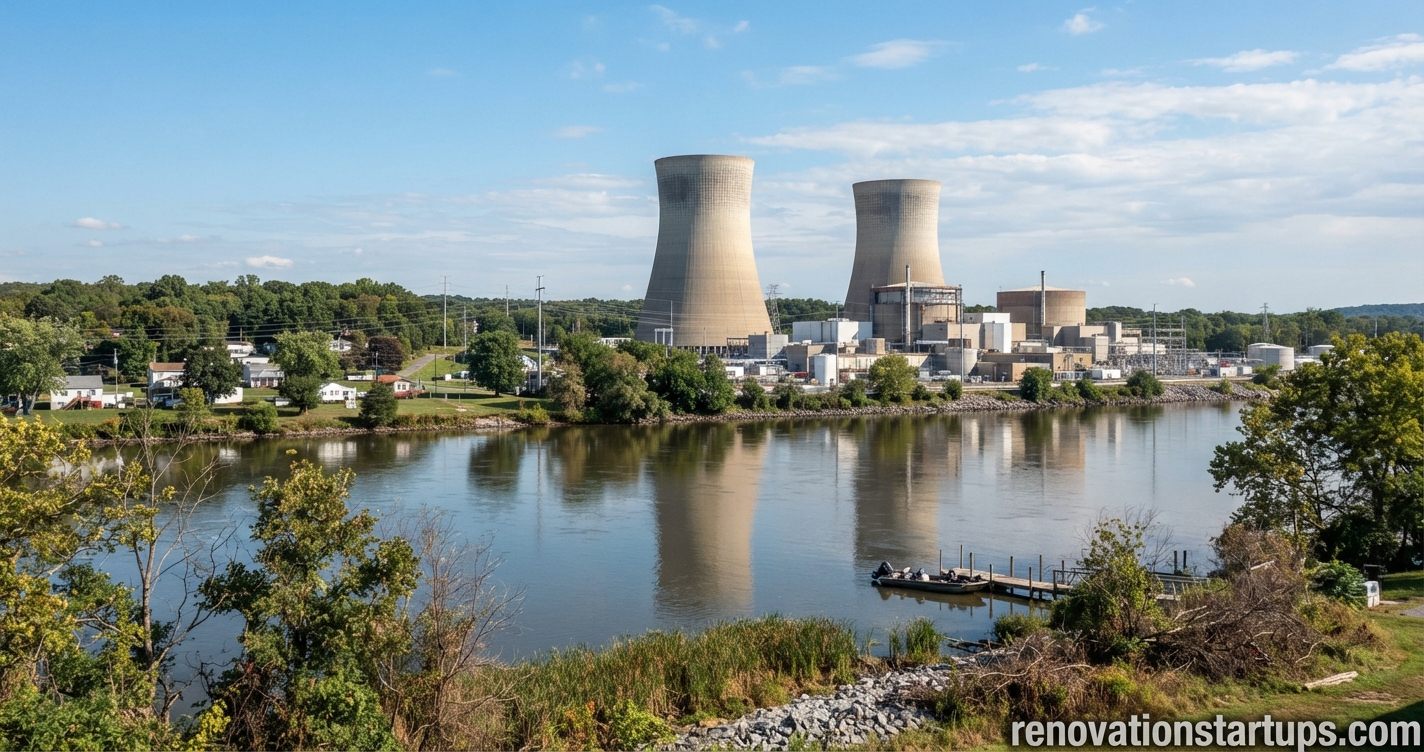
Three Mile Island is a nuclear power station on the Susquehanna River in Pennsylvania. On March 28, 1979, the reactor in its Unit 2 building partly melted down, causing the most serious accident in US commercial nuclear history. Nobody was killed, and the radiation reaching the public was small. Even so, the event changed how reactors are operated, regulated and explained, in Canada as much as anywhere.
Hi friend If you landed here after a headline about data centres and nuclear restarts, you are not alone. We hear this question constantly, and I think the human story beats the engineering one. Shall we start at the beginning?
What Happened at Three Mile Island on March 28, 1979?
The station sits on an island of about 3.3 square kilometres near Harrisburg, and it had two pressurized water reactors. Unit 1 was shut for refuelling. Unit 2 had been in commercial service for only about three months and was running near full power when, shortly after 4 a.m., a problem in the secondary cooling system tripped the turbine and the reactor shut itself down. That part worked as designed. What followed did not.
A Relief Valve That Would Not Close
Pressure climbed, and a relief valve opened to vent it. Then it stuck open. For more than two hours, coolant drained away while a control room light suggested the valve had been told to close, which is not the same as being closed. One misleading signal, hours of confusion.
Instruments That Told the Wrong Story
Gauges seemed to show plenty of water in the system, so operators throttled back emergency cooling. In reality, steam had displaced the water and the core was uncovered. It took more than two hours before anyone spotted the stuck valve and closed a backup valve to stop the leak. About half of the core melted. Investigators later pointed to design weaknesses, equipment failures and human error working together, not a single villain.
Evacuation Advice and Public Fear
On March 30, Pennsylvania’s governor advised pregnant women and preschool children within eight kilometres to leave. Many other people left anyway. Officials were caught off guard, and conflicting statements fed the alarm. Could you make that call with half the facts?
How Much Radiation Did People Receive?
Very little. The highest estimated dose to any member of the public was about 0.7 millisieverts (70 millirem), and the average for roughly two million people within 80 kilometres was far lower, around 0.01 millisieverts. For scale, that top figure is a fraction of the natural background radiation Canadians absorb in a year from soil, air and cosmic rays. More than a dozen epidemiological studies since the early 1980s found no discernible direct health effects. The clearest documented harm was psychological, since residents nearby reported more anxiety and distress than people elsewhere.
Honesty matters here, so you should hear the other side too. Some independent researchers question the dose assumptions and report cancer patterns near the site, while mainstream reviews have not confirmed a link. Reading the official reports next to the critics’ papers, we noticed the argument centres on how much escaped, not on what happened inside the plant. That gap is worth knowing about before you trust any single source, including this one.
How Did the Accident Change Nuclear Safety?
A presidential commission concluded that the fundamental problems were people-related, not only equipment-related. After Three Mile Island, the industry had to accept that a reactor can fail through ordinary mistakes, not only dramatic ones. Three changes stand out.
Operator Training
Full-scope simulators became standard, so crews could rehearse exactly this kind of slow, confusing emergency before ever facing one. Plenty of control rooms around the world now run drills for scenarios with misleading readings.
Control Room Design
Designers rethought how alarms and indicators are laid out, so that one ambiguous light cannot mislead a whole shift. Instruments now aim to show what a component is actually doing, not what it was ordered to do.
Clearer Public Communication
Regulators and utilities learned that silence and mixed messages do real damage. In 1979, people feared the unknown far more than the actual release, and nobody could blame them. Plain, early and consistent updates became part of emergency planning, and Canadian regulators took that lesson seriously, as the next section shows.
How Did Canada Respond After Three Mile Island?
Canada has never had a reactor meltdown, and our CANDU reactors are a different design, using heavy water and natural uranium. Still, in 1980 the national regulator of the day, the Atomic Energy Control Board, stepped up its public communication and became more transparent.
In 1984, Ottawa created the Federal Nuclear Emergency Plan, with Health Canada coordinating, partly because of this accident and the 1978 crash of a Soviet nuclear-powered satellite in the Northwest Territories. Before that, no single federal department had clear responsibility. Today the Canadian Nuclear Safety Commission, created in 2000, oversees reactors in Ontario, Quebec and New Brunswick through licensing and periodic safety reviews. If you live in Ontario, that oversight covers the stations that supply a large share of the province’s electricity.
Is Three Mile Island Being Restarted?
Partly, yes. Unit 2 never ran again. The cleanup took years, with crews removing damaged fuel remotely using cameras and long-handled tools until the work finished around 1990. The core debris went to a federal facility, and the reactor now sits in monitored storage. Unit 1 is a separate reactor that ran until 2019, when it closed for economic reasons.
Constellation Energy signed a 20-year power purchase agreement with Microsoft to bring Unit 1 back as the Crane Clean Energy Center, adding about 835 megawatts. The company has repeatedly pointed to a 2027 return, and fuel assemblies and a main transformer are already on site. Regulators have also approved a grid-connection waiver. Nuclear schedules slip, so treat that year as a target, not a promise.
FAQ
Is Three Mile Island Still Radioactive?
The fuel and core debris from Unit 2 were removed, contaminated water was processed, and the remaining structure is monitored. Low-level residual contamination stays under control. The damaged reactor is kept in long-term storage rather than demolished.
How Many People Died at Three Mile Island?
None. No deaths or injuries were attributed to the accident. Three plant workers did receive doses of about 3 to 4 rem (30 to 40 millisieverts), above the quarterly limit, so exposure was not zero.
Could a Three Mile Island Accident Happen in Canada?
No design carries a guarantee, and I would distrust anyone who claims otherwise. Canadian plants use a different reactor type and operate under licence conditions with regular reviews. Those layers lower the odds, but they do not erase them.
Was It as Serious as Chernobyl?
No. It was rated level 5 on the seven-level international nuclear event scale, while Chernobyl was level 7, a rating Fukushima in 2011 also received. The containment building held, and the release to the environment was small by comparison.
