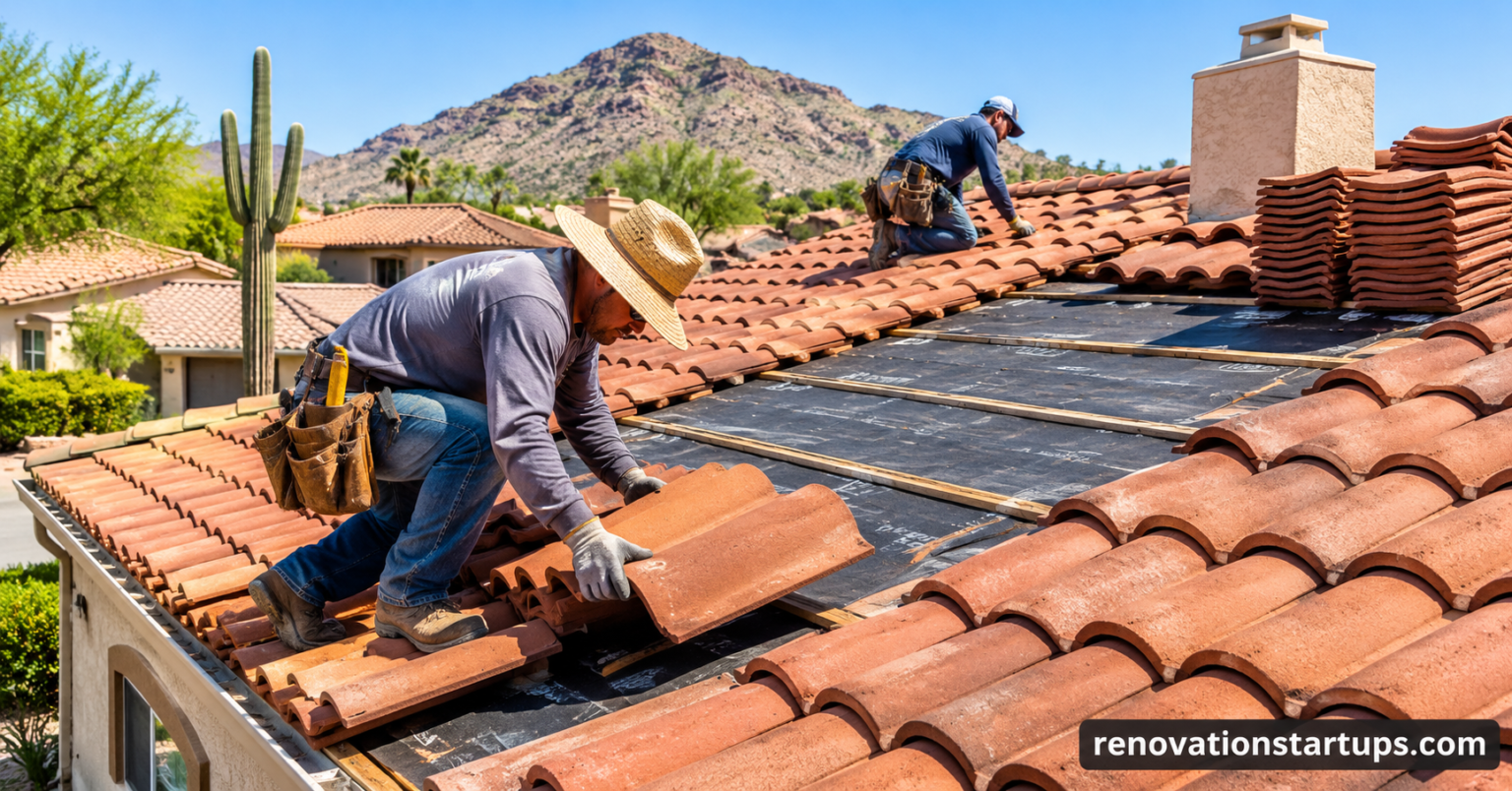
Tile roofing covers a home with interlocking concrete or clay units over a waterproof layer, the underlayment.Tile Roofing & Lift-and-Relay in Phoenix Builders across the Valley of the Sun chose it because tile handles extreme desert heat. Sound tile often outlasts the layers beneath it.
What is tile roofing in Phoenix, and why do so many homes use it?
Most homes use flat concrete tile, while historic districts and custom homes often use clay barrel tile. Tile vs shingle in Phoenix often comes down to lifespan, since a tile roof lifespan 50+ years outlasts shingle, while cool-rated shingles, standing-seam metal roofing, foam roofing (SPF), and ENERGY STAR cool tile (Eagle Bel Air) fill other needs. Flat roof repair, roof recoating, and ponding water (flat sections) matter on flat areas.
What is a tile lift-and-relay, and is lift-and-relay a tile roof replacement?
A tile lift-and-relay removes the tile, replaces the waterproofing beneath it, and sets the same tile back. Crews lift and stack the tile, strip old underlayment, install the new layer, and relay original tile. It usually is not a tile roof replacement, because the original tile stays.
Contractors also call the job tile underlayment replacement or lift-and-relay underlayment replacement. A full tear-off with new tile suits failed tile, and full tile replacement also changes the profile. Ask which one your scope describes.
When does a Phoenix tile roof need new underlayment?
A tile roof usually needs new underlayment at 18 to 22 years, a range Power Peak Roofing and CheckedHomePros both cite. Aging underlayment on south and west slopes often fails first, says All Valley Roofing. An underlayment age assessment starts with your build year, and 1990s tile subdivisions like Ahwatukee Foothills and Desert Ridge now sit inside that window.
Underlayment failure shows up as recurring roof leaks, interior ceiling stains, or leaks despite tile that looks fine from the street. In the attic, look for daylight visible at the ridge from the attic and for underlayment debris in gutters. Cracked pipe boots, crumbling mortar, and sliding tiles add more evidence.
What damage hides under the tile?
Moisture often travels under tile for years before it stains a ceiling. When crews lift the tile, they find deck delamination, trapped condensation, and attic moisture damage that nobody could see from above. CheckedHomePros reports this pattern on older OSB sheathing in Phoenix neighborhoods.
Soft or damaged deck boards force the crew to replace plywood sheathing or OSB sheathing on the roof deck first. A deck inspection before the quote exposes that risk early. A sheathing inspection adds one to two days to a full tear-off, according to CheckedHomePros.
How do you choose between lift-and-relay and full replacement?
Choose lift-and-relay when the tile stays sound and breaks stay limited, and choose replacement when cracking spreads. CheckedHomePros draws a rough line at more than 10 percent cracked tile. A tile condition survey gives you that number for your roof.
A lift-and-relay vs replacement decision guide should weigh brittle tile, flaking tile, and discontinued profiles. Tile color-matching works only when matching pieces exist. A few cracked tile and missing tile pieces still fit a relay, and slipped tile resetting fixes small local problems.
What should a scope of work include?
A solid scope names the underlayment type, every flashing, the ridge system, and the tile count in writing. It lists products, not just categories, so you can check each one later. Vague proposals hide the small items that cause tomorrow’s leaks.
Ask for valley metal, pipe flashing, pipe boots, vent flashing, chimney counter-flashing, and skylight curb flashing by name, as CheckedHomePros recommends. Galvanized flashing and copper flashing both appear in its description. An itemized proposal also lists roof fasteners, parapet cap work, and any scuppers.
Which underlayment and ridge materials do Phoenix tile roofs use?
Phoenix contractors mostly choose between 30# organic felt, synthetic underlayment, and self-adhered underlayment. Power Peak Roofing and CheckedHomePros both name Polyglass Polystick TU Plus, a high-temperature underlayment. CheckedHomePros also describes 2-ply 40# ASTM D226 Type II felt as a code-level option.
Old hip and ridge mortar crumbles when crews lift tile, so many relays use a mechanical ridge system such as Boral FlexRidge or RidgeMaster Plus. Hip and ridge repair and bird-stop repair belong in the scope when gaps open around the bird stop. Power Peak Roofing names Quarrix Bird Stop & Ridge for ridge ventilation and bird blocking.
How does a typical job run from inspection to final inspection?
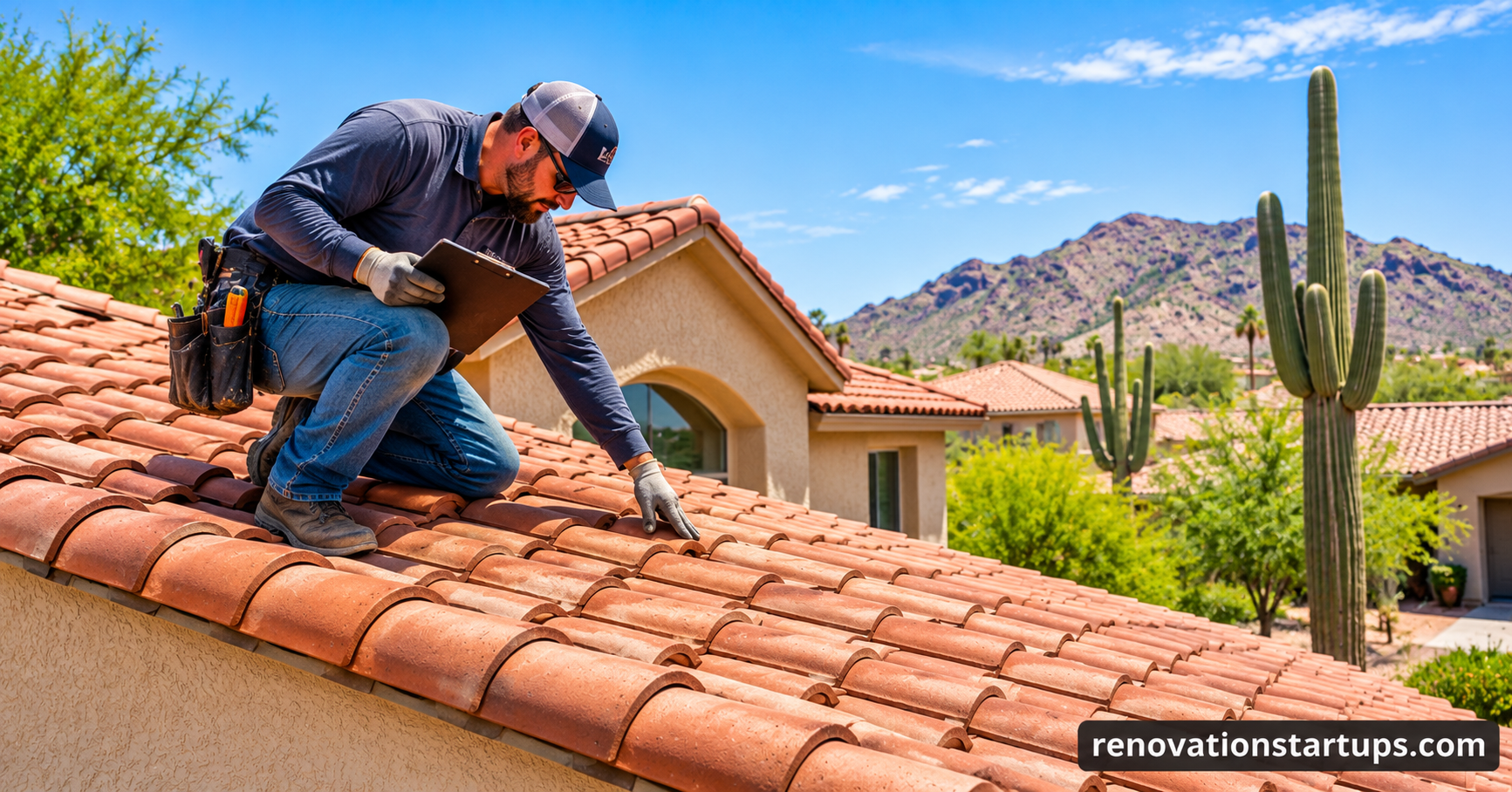
A typical job starts with a free tile roof inspection and ends with a final inspection. Power Peak Roofing describes the order as inspect, lift and stack, strip old underlayment, install the new layer, and reset the tile. Warranty paperwork closes out the job.
Crews use palletized tile stacking, then relay original tile once the deck is ready. They also perform tile re-fastening and tile reset to wind code so the field holds in storms. A photo-documented inspection report gives you a record to compare with the finished work.
What permits, HOA rules, and historic rules apply?
Simply Roofing reports that Phoenix requires no building permit for same-material re-tiling, while CheckedHomePros advises asking whether your provider pulls a City of Phoenix reroof permit. The two sites differ, so confirm the rule with the city. A building permit for change of roofing type covers a shingle-to-tile conversion.
CheckedHomePros cites 2018 IRC R803 for damaged sheathing, and Power Peak Roofing ties tile re-fastening to monsoon wind code. HOA architectural review comes first for color changes, so read your CC&Rs and request Architectural Review Committee approval 30 days ahead. On a Historic Property Register home, the Historic Preservation Office decides, with a Certificate of No Effect for same-material work and a Certificate of Appropriateness for larger changes.
How do Phoenix heat and monsoons damage tile roofs, and what helps?
Extreme desert heat and intense UV exposure age roofing layers faster here than in milder cities. Simply Roofing reports daily swings above 30 degrees Fahrenheit, which drive thermal expansion and contraction. That cycle causes thermal stress cracking in tile, while UV degradation and flashing failure follow.
Monsoon season brings monsoon damage, wind damage, and hail damage, so schedule a pre-monsoon roof inspection or a pre-monsoon roof tune-up in spring. After a storm, call for emergency roof repair if water enters, and ask about storm damage insurance claim support. Tracing the leak source matters, because water often enters a few feet from the stain.
How do solar panels change a tile roof job?
Solar panels add steps because crews must remove them before lifting tile. All Valley Roofing, CraftBuilt Roofing, and Simply Roofing each list solar-related roof work. A solar panel detach and reset needs a clear owner, so ask who handles the electrical side.
Leaks around solar mounts rank among the common repairs on newer Laveen roofs, Simply Roofing reports. Solar mounts pierce the tile and the underlayment, so inspect them each spring. Ask whether your quote includes resealing every mount.
Which brands and products appear on Phoenix tile roofing websites?
The five sites name different tile and underlayment products on their own pages. Power Peak Roofing names Eagle Roofing concrete tile, Westlake Royal Building Products, and Quarrix Bird Stop & Ridge. CheckedHomePros names Eagle Capistrano, Boral Saxony, and Hanson Roof Tile.
CraftBuilt Roofing displays GAF Master Elite, Malarkey Roofing Products, and Brava Roof Tile. Power Peak Roofing also lists Owens Corning, CertainTeed, SRS Building Products, and ABC Supply among its suppliers. Those names show materials, not which services a company offers.
What services does each company’s website confirm?
Each company offers the services its own website lists, so treat that site as the source of truth. This section reports only what the five pages state, nothing more. Check each company’s service pages for current details before you call.
Power Peak Roofing and CheckedHomePros list Scottsdale and Paradise Valley, and providers also work across the East Valley, the Greater Phoenix metro, and Maricopa County. The pages differ in type: tile page, blog guide, directory, and area pages. Compare like with like.
What does Power Peak Roofing list for tile roofing?
Power Peak Roofing lists concrete tile installation and clay tile installation for new construction and re-roofs, tile lift-and-relay with new underlayment, and broken tile replacement with color-matching. It also lists tile valley repair, bird-stop repair, ridge cap repair, and tile re-fastening to monsoon wind code. Its page adds a free tile roof inspection with a photo report.
What does All Valley Roofing list?
All Valley Roofing states that it handles repairs, underlayment lift-and-relay, and full tile replacement when its Free Roof Report supports them. The report gives you photos and plain findings either way. The company also plans roof work with a solar detach and refit partner.
What does CheckedHomePros list?
CheckedHomePros works as a directory and does no roofing itself. Its tile page describes lift-and-relay and full tear-off with new tile, and it links to tile underlayment replacement, tile roof repair, and roof inspection pages. It offers vetting standards rather than crews.
What does CraftBuilt Roofing list?
CraftBuilt Roofing’s Phoenix page mentions lift-and-relay renewals that fix leaks without replacing good tile. Its list includes concrete tile roofing, leak repair, flashing repair, attic ventilation, and storm, hail and wind repair. It also lists insurance restoration and solar panel removal and reinstallation.
What does Simply Roofing list?
Simply Roofing lists tile roof repair, tile underlayment replacement, and full roof replacement for Phoenix homes. Its page describes lifting and stacking tile, installing new high-temperature underlayment and flashing, and laying the same tile back. It also lists emergency repair, maintenance, shingle, metal, foam and flat roofing, and permit handling.
What should you verify about a provider before you sign?
Start with ROC license verification on the Arizona Registrar of Contractors site, and confirm the roofing license class, such as the AZ ROC C-42 license that CheckedHomePros requires. All Valley Roofing links to the registrar. Ask for the license number in writing.
Then ask about workmanship warranty terms and manufacturer warranty registration. Power Peak Roofing lists warranty paperwork in its process, and Simply Roofing states a 10-year workmanship warranty with a 25-year option. Keep the terms in writing.
Why is this website the easiest way to find a provider?
This website gathers the checks above in one place, so you compare providers against the same list instead of starting over with every call. You see scope items, license steps, and warranty questions side by side. That saves time when a roof starts leaking.
Use the site to shortlist providers that list tile services, then read each company’s own page to confirm details. Bring your home’s build year, photos of ceiling stains, and your HOA rules. Those three items help any provider scope your job faster.
What are the most common questions about tile roofing in Phoenix?
How long does tile last in Arizona?
Concrete and clay tile often last 50 years or more, according to several of these company sites. The underlayment lasts far less, commonly 18 to 22 years for felt in Phoenix. Plan your timeline around the layer under the tile.
Does lift-and-relay save my original tile?
Yes, when the tile passes inspection, because the crew reuses it and replaces only the broken pieces. Expect some breakage during handling, since tile cracks when workers lift and stack it. Ask your provider how many spare tiles it will source.
When should you book an inspection?
Book in spring, before monsoon season starts on June 15, or right after a storm or a new ceiling stain. A spring check catches problems before storms move loose tile around your roof. Ask for photos with every report you get.
What is the next step for finding tile roofing in Phoenix, Arizona?
Use this guide to write your checklist, then visit this website to compare providers of tile roofing and lift-and-relay in Phoenix, Arizona. Read each company’s own page to confirm all its services. Bring your roof’s age, your photos, and your questions to make the comparison easier.
