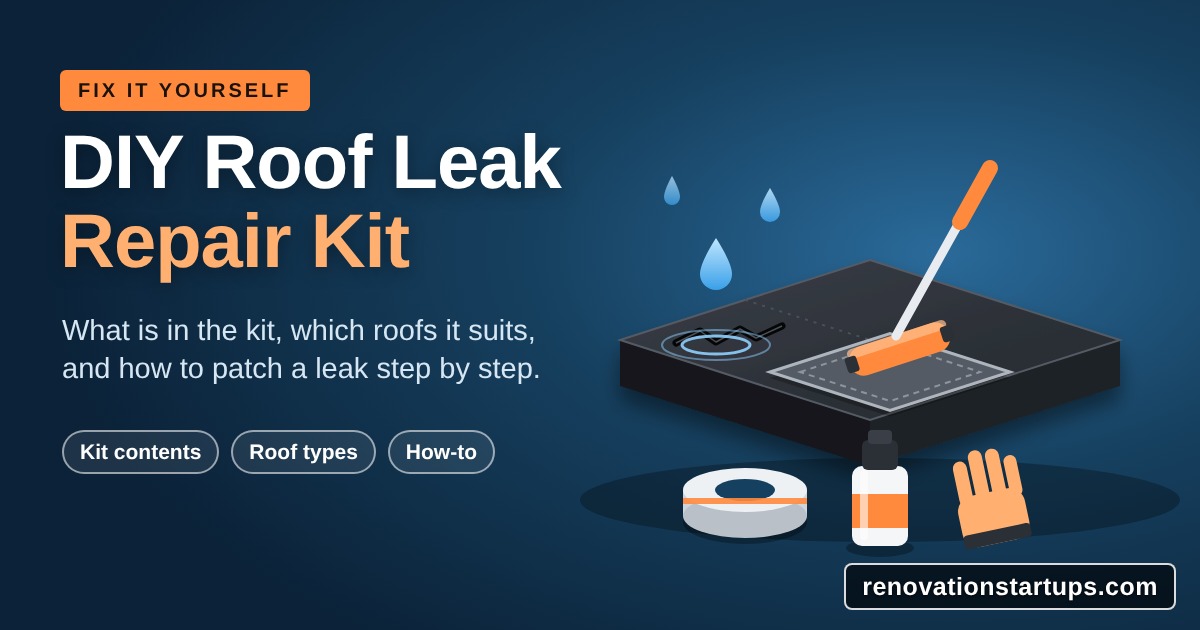
A DIY roof leak repair kit packages the coatings, reinforcement, and tools for fixing a small leak without a contractor. Homeowners, property managers, and maintenance managers reach for a roof repair kit when damage stays limited to a crack, a seam, or a small puncture. Bigger structural failures still call for a professional inspection.
Most people search for a roof leak repair kit after a storm, when a ceiling stain spreads and a roofer’s quote arrives. A small roof repair kit often handles the job, while a roof restoration kit treats an entire surface. I tell readers to match the kit to the damage, because an oversized kit wastes money and an undersized one stalls.
What Comes Inside a Roof Repair Kit?
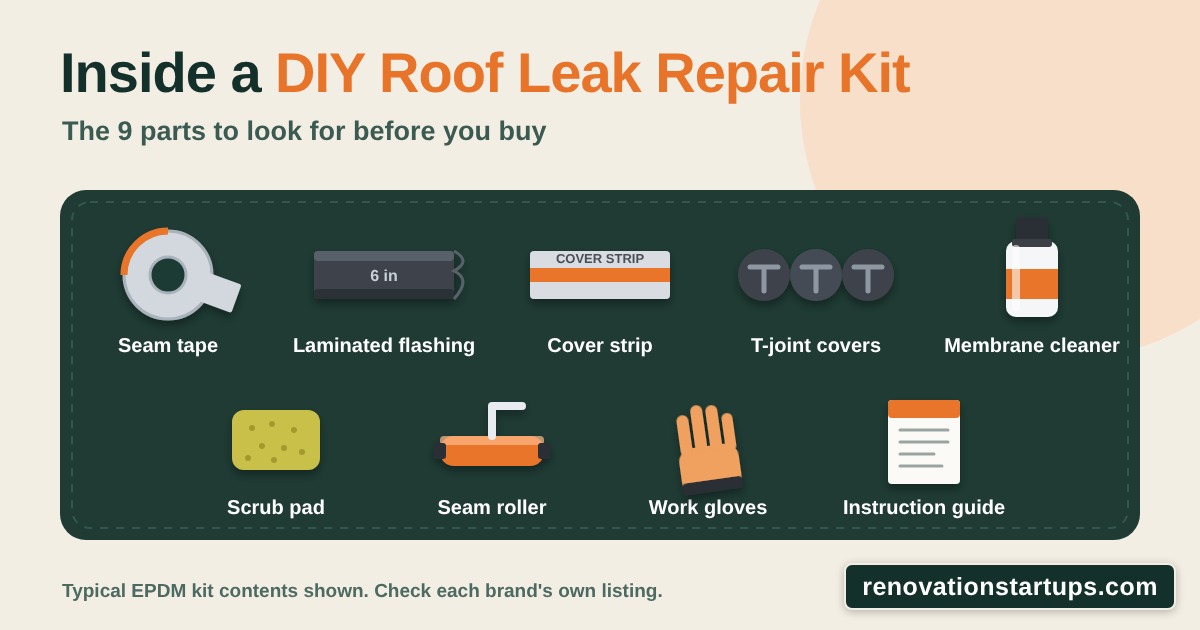
A roof repair kit typically packs a sealing material, a reinforcement layer, and the tools to apply them. The VXB EPDM roof patch kit, for example, lists 10 feet each of laminated flashing, cover strip, and seam tape. It also adds three T-joint covers and two 8-ounce containers of membrane cleaner.
The 6-inch flashing works as a patch and as flashing material around edges, while the seam tape closes watertight joints. A scrub applicator pad, a seam roller, and work gloves round out the same box. VXB also includes an application instruction guide and a safety data sheet (SDS) for every component product.
Which Coatings and Reinforcements Do Liquid-Applied Kits Use?
Liquid-applied kits swap patches for liquid rubber that cures into a seamless membrane. The Lava 20 2m² kit pairs 6 kg of Lava 20 with 750 ml of fast primer, 4 square meters of chop strand matting, and 2 meters of polyester tape. A 300 ml tube of PU mastic covers edges and details.
Larger Lava 20 kits add polyester reinforcing tape, and the brand sells a white top coat, quartz anti-slip, and an accelerator, plus an anti-slip coating on request. Seal All skips the primer with its primerless technology and labels its Energy Star rated system “Keeps Roof Cool.” A reflective roof coating bounces sunlight away, and a cool roof coating can trim cooling demand.
Which Roof Surfaces Can a Repair Kit Handle?
Most kits target specific membranes, so the label matters more than the brand name. An EPDM rubber roof, a single-ply roof, and a flat roof all suit membrane-style kits, and a flat roof repair kit usually fits a low-slope roof too. Water must drain away rather than pond.
Seal All names aged single-ply membranes such as TPO, PVC roofing, EPDM, and Hypalon on its home page. It also lists modified bitumen, built-up roofing, roll roofing, and asphalt roof surfaces. A previously coated roof appears on both Seal All’s and Lava 20’s lists, though Lava 20 asks for proper surface preparation first.
Can You Use a Kit on Shingle, Metal, and Tile Roofs?
Yes, but only with a kit that names the surface. Seal All lists a metal roof, a shingle roof, and a barrel tile roof among its surfaces, along with RVs and trailers, sheds and shipping containers. Check the label before you buy, because a coating that grips metal may not bond to everything.
Lava 20 adds a felt roof, a fibreglass roof, a timber roof, and a spray foam roof to that list, plus cement board, insulation boards, and a concrete roof deck. Its Surfaces menu spells these out. I always open the surface page first, since it shows which prep steps apply.
What Causes Roof Leaks, and How Do You Find the Source?
Storm damage and an aging roof cause most roof leaks. Flat roof leaks usually start at holes and punctures, membrane tears, damaged flashing, or leaking seams. Water intrusion rarely appears right below the opening, so leak detection starts on the roof, not the ceiling.
Start with a roof inspection on a dry day, and follow ladder safety rules, fall protection practices, and personal protective equipment. Trace the stain inward, then scan for minor roof cracks, weak joints, and surface damage. Finding the leak source before you buy shows whether you need a patch or a full restoration.
Why Do Some Roof Repairs Fail?
Repairs fail when they cover the stain and ignore the root cause of leaks. Temperature changes and surface movement reopen cracks and joints, so a rigid patch often cracks again. Stopping leaks at the source means sealing the opening and reinforcing the area around it.
Lava 20’s page makes this point, saying traditional patches fail at joints and overlaps. The company claims its waterproofing membrane flexes with movement and blocks water penetration before interior water damage starts. Check what proof the company publishes.
How Do You Repair a Roof Leak Step by Step?
Clean, prime, reinforce, coat, and cure, in that order. Lava 20 lists five steps: clean the roof surface, apply primer, reinforce cracks and joints, apply waterproof membrane, and allow cure time. Seal All compresses the process into its three-step roof repair system.
Surface preparation decides whether any of it sticks, so scrub off dirt, loose granules, and old residue first. Choose dry weather application, because moisture weakens adhesion and slows curing. Read the technical data sheet for temperature limits, and follow the kit’s application instructions closely.
How Do You Seal Seams, Flashing, and Cracks?
Match each problem to its material: seam sealing for lap joints, flashing repair around vents and edges, and patch repair for holes and tears. Press every layer down with a seam roller to push out trapped air. A rolled seam grips better than a hand-smoothed one.
Lava 20 says “no specialist tools required” for its DIY flat roof repair process, and Seal All offers a how-to video. Seal All also describes a renewable roof system that lets you recoat roof surfaces repeatedly, which suits a later roof refurbishment. D.I.Y. EPDM Rubber Roof Repair Kit links an emergency winter roof repair guide.
What Should You Look for in a Roof Repair Kit Provider?
A good provider names the surfaces its product suits, lists what the kit contains, publishes clear instructions, and states its warranty terms in plain language. Those four checks separate a contractor-grade roof kit from a vague listing. Commercial-grade components and a helpline add confidence.
Cost matters, and a kit gives homeowners a cost-effective alternative to roof replacement. D.I.Y. EPDM Rubber Roof Repair Kit’s site states that roofing contractors charge $750 or more per service call, so minor jobs you handle yourself can save on contractor fees. Seal All says its system extends roof life.
Which Warranties and Approvals Should You Check?
Check the warranty length, what it covers, and who backs it. Seal All shows a lifetime roofing warranty and a Miami-Dade County approved mark, while Lava 20 states a 25-year warranty. D.I.Y. EPDM Rubber Roof Repair Kit offers a 90-day money-back guarantee.
Read the full warranty page before trusting any badge, since each page carries its own conditions. Seal All links a separate warranty page, and Lava 20 pairs its 25-year figure with a lifespan estimate of up to 20 to 25 years with proper application. Confirm the wording on the brand’s site when you buy.
What Does Each Brand Offer on Its Own Website?
Each brand offers the products and support listed on its own website, and none of the pages we checked lists installation by a crew. Seal All Roof Kit, D.I.Y. EPDM Rubber Roof Repair Kit, Lava 20, and VXB all sell kits for self-application. Confirm current details on each page before you order.
Names, kit sizes, and shipping terms change, so treat this section as a map. Each brand below gets only what its own page confirms. Documents marked coming soon stay out.
What Does Seal All Roof Kit Offer?
Seal All Roof Kit sells a contractor-grade DIY roof leak repair kit, plus individual components for buyers who need only part of the system. Its home page describes a three-step application, primerless technology, and a coating for metal, single-ply, asphalt, shingles, and barrel tiles. It also lists a helpline, how-to videos, FAQs, and a warranty page.
The page lists compatible surfaces from previously coated roofs to RVs and trailers, plus sheds and shipping containers. It links the cool roof coating to energy savings and lower energy usage. Same-day shipping appears in its header.
What Does D.I.Y. EPDM Rubber Roof Repair Kit Offer?
D.I.Y. EPDM Rubber Roof Repair Kit sells three kit options: PRO for most jobs, BIGG BOSS with more flashing, and a refill kit without tools. The refill kit pairs with either larger option when a job runs out of material. The site states free shipping in the continental US and a 90-day money-back guarantee.
Its pages target flat roof leaks on EPDM membranes for small businesses, condo associations, churches, and homeowners. The site pairs its rubber roof repair kit with a blog and instruction pages that walk through the repair. Pick it when your membrane is EPDM.
What Does Lava 20 Offer?
Lava 20, from Owl Waterproofing, offers a liquid waterproof membrane kit in sizes from 2 to 1,000 square meters. The 2m² kit suits cracks and joints, balcony waterproofing, gutter repairs, and patch repair. The site also sells an emergency patch repair kit and a fiber reinforced roof and crack repair kit.
Buyers will also find a roof kit calculator, a complete waterproofing system with a top coat, and free dry sample kits. The brand states a 25-year warranty and lists training with its experts and a distributor program. Its application, technical, and guide tabs read coming soon on the page we checked.
What Does VXB Offer?
VXB, a bearings retailer, lists one EPDM kit for holes and punctures, membrane tears, and damaged flashing on flat and low-slope EPDM roofs. The listing names homeowners, church facilities, and facilities managers as its audience. The page states free US shipping and free returns.
VXB’s page calls the materials contractor-grade and says they extend roof life and help prevent water intrusion. The kit ships with an instruction guide and SDS sheets, but the page lists no installation service. Treat it as a patch purchase, not a full service.
Is a DIY Roof Leak Repair Kit Worth It?
A kit pays off when the damage is small, you know your roof surface, and you can work safely at height. Seal All and Lava 20 both present their systems as a permanent leak solution, though results still depend on prep and weather. Large failures need a roofer’s assessment before any coating goes down.
Lava 20 says its membrane prevents future leaks and protects roof long-term, and it lists long-lasting protection, strong adhesion, and a flexible and crack-resistant finish. It also claims a professional-quality finish, a durable waterproof finish, and seamless protection. Treat these as brand claims, not guarantees.
Where Can You Find a DIY Roof Leak Repair Kit in Texas?
Our website renovationstartups.com collects these checks in one place, so you can compare a DIY roof leak repair kit for Texas roofs without opening a dozen tabs. Use it to review each brand’s listed surfaces, kit contents, and warranty, then confirm details on the brand’s own page. Match the kit to your roof before you climb the ladder.
What Do People Ask Most About DIY Roof Leak Repair Kits?
Which Kit Suits an Emergency Repair?
A fast patch kit suits an emergency leak stop, as a stopgap before a full repair. Lava 20 sells an emergency patch repair kit, and its fiber reinforcement targets cracks on flat or low-pitched roofs, balconies, and gutters. The D.I.Y. rubber roof site also publishes an emergency winter guide.
Can a Kit Repair Commercial Roofs?
Sometimes, for minor damage. Lava 20 lists kits up to 1,000 square meters, and Seal All targets property managers and maintenance managers alongside homeowners, so both reach beyond small jobs. Commercial roofs still need a written roof inspection, a safety plan, and a check against local code before any work starts.
