
Every home, shop, and office in Canada needs a simple way to be found, and the first piece of that puzzle is a small set of digits fixed to a wall or a post. Most people use those digits every day without knowing their official name.couriers, and emergency teams reach you without guessing. A lot only receives its digits after something is built on it.
What a Civic Number Really Means in Canada
A civic number is the identifier given to a building so it can be told apart from every other building along the same road. Canada Post uses this term for the digits at the start of an address line, such as the 602 in 602 East 87th Avenue. The digits point to a structure, whether that is a house, a school, an apartment block, or a workshop. They do not point to the road itself, and they are not attached to an empty piece of land. A lot only receives its digits after something is built on it.Think of it as the name tag of a building. The road name tells people which street to enter, and the building number tells them which door to stop at. One missing digit can cause long delays.
How Canadians Read an Address Line
A typical Canadian address has several layers. First comes the building number, then the road name with its type and direction, then the town or city, the province, and finally the postal code. Each layer narrows the search area a little more, until only one entrance remains.
The Number Before the Street Name
The opening digits usually rise as you travel along the road. In most places, odd numbers sit on one side and even numbers sit on the other, which helps drivers guess where to look. Spacing is often tied to distance, so do not expect every neighbour to hold the next number in order.
Where Unit and Suffix Details Fit
Apartments and shared buildings add extra details. Postal guidance places a unit number in front of the building number, joined by a hyphen. A letter added right after the digits, such as 123A, is written with no space between them. Mail sorting machines read these small details in a fixed order civic number.
Why Street Number Is the Wrong Label
In everyday talk, many people call the first part of an address the street number. That phrase can confuse newcomers, because some roads are themselves numbered, like 87th Avenue. In that case, the number inside the road name is the real street number, while the digits at the front belong to the building..
Who Assigns House Numbers in Your Municipality
A civic number is never picked by the owner. A municipal office, usually the planning or addressing department, hands them out according to local rules. For new construction, the number commonly arrives after a building permit is approved, and the details are then shared with emergency dispatch, the postal service, and utility companies. Residents are told not to give themselves a number, since a random choice could clash with the system that responders rely on.
Rural Addressing and Blue Signs
Country roads follow a different pattern. In parts of Alberta, for example, rural addresses use a five or six digit number tied to a position along the road, paired with the road name. Many rural areas also require a reflective sign so the digits can be spotted from a moving vehicle at night.
How Rural Numbers Differ From City Numbers
City numbers climb in small steps along a block, while rural numbers often reflect how far a property sits from a starting point. An even number may sit on the west or south side of a road, and an odd number on the east or north side.
Why Reflective Plates Matter
Blue plates with white reflective digits are common in several provinces. They bounce headlight beams back toward the driver, so a fire truck can read the digits quickly after dark. Replace a faded or missing plate as soon as possible.
Emergency Crews and the Role of Your Number
When someone calls 911, the digits at the front of the address become the main clue for locating the caller. Dispatchers enter the full address into a database, and crews then drive to the exact building. Utility providers and delivery companies lean on the same data when they connect services or drop off parcels. A civic number that is wrong in even one record can send help to the wrong place.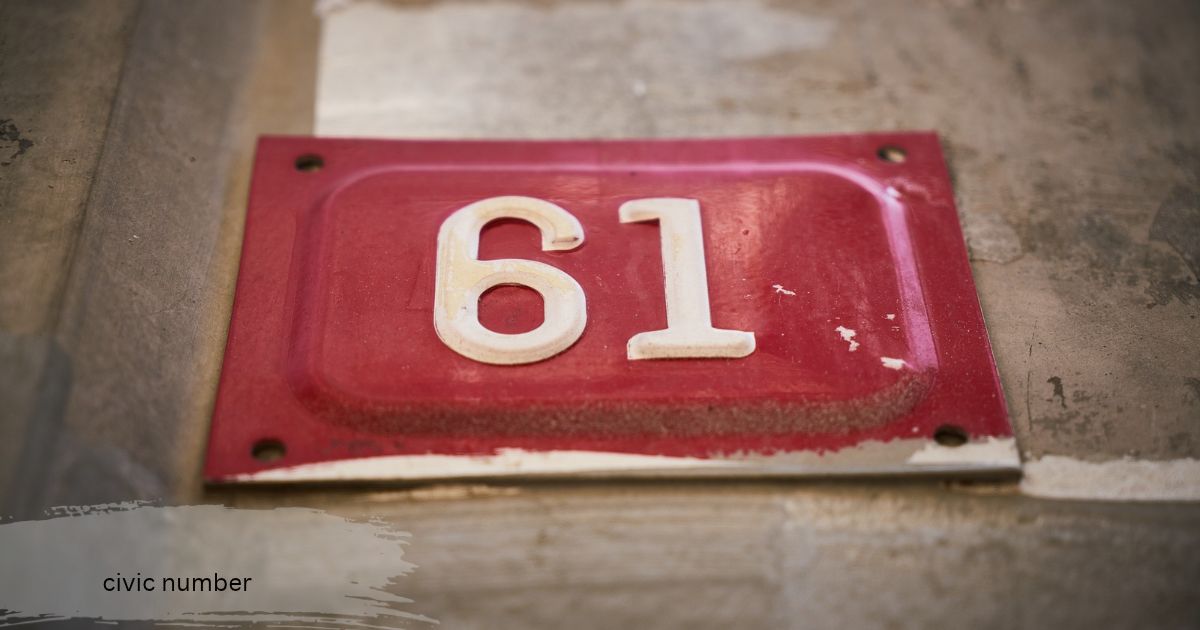
Rules for Posting Your Number Clearly
Most municipalities share similar rules for posting a civic number. Use regular Arabic digits, such as 12, instead of Roman numerals or spelled out words. Place the number high on the building, mailbox, or a sign post, where snow and bushes cannot hide it during any season. Pick a colour that contrasts with the background, like black on white, and avoid gold on beige.Size matters too. In New Brunswick, digits on a building or post within fifteen metres of the road should be at least 65 millimetres tall, and digits farther back should reach 100 millimetres. Never fix the digits to a road sign, a telephone pole, or a hydro pole, because those belong to other agencies. Face them toward the road so drivers can see them from both directions.
Simple Steps to Track Down a Lost Property Number
If your number is unclear, start with paperwork you already have. A property tax bill, a title deed, or mortgage documents usually show the full address. A neighbour’s address can also help you work out the pattern on your road. If these do not answer the question, contact the municipal planning office, since staff there manage the numbering system. Once you have the answer, save it near the phone so every family member can recite it quickly.
Common Mistakes That Delay Mail and Help
One frequent error is assuming a mailing address and a physical address are identical. In some rural areas, mail goes to a post office box or a rural route while the physical address carries a separate number. Another mistake is using different digits on tax forms, courier apps, and online maps, which makes records disagree. A quick yearly check of your sign, your mail records, and your map listing avoids most of these problems. Spending ten minutes on this review each year can save you hours of frustration, missed parcels, and worried phone calls when someone cannot locate your front door after dark or during bad weather.
Conclusion
A civic number may look like a tiny detail, but it keeps a whole system running, from mail delivery to emergency response. It belongs to a building, it is handed out by your local government, and it works best when it is posted high, large, and in a contrasting colour. Check that your sign is readable from the road, confirm that your records match, and use the correct term whenever you fill out a form. These simple habits protect your household and make life easier for everyone who needs to find your door.
FAQs
What is my civic number in Ontario?
It is the building number that appears at the start of your address line, just before the road name. You can confirm it on a property tax bill, a utility statement, or the sign posted at your home. If you are still unsure, your municipal office can verify it.
How is a civic address different from a street number?
A civic address is the full location of a building, including the building number, road name, and municipality. A street number, in the strict sense, would only be the number found inside a numbered road name, such as the 87th in 87th Avenue.
What does a letter after a house number mean?
A letter placed right after the digits, like 123A, separates buildings or units that share the same base number. It is written without a space so postal systems can read it correctly.
How do I find my address number in Alberta?
Check the sign at the start of your driveway, since rural properties often have a blue reflective plate. You can also look at your tax notice or ask your county or municipal district office to confirm it.
