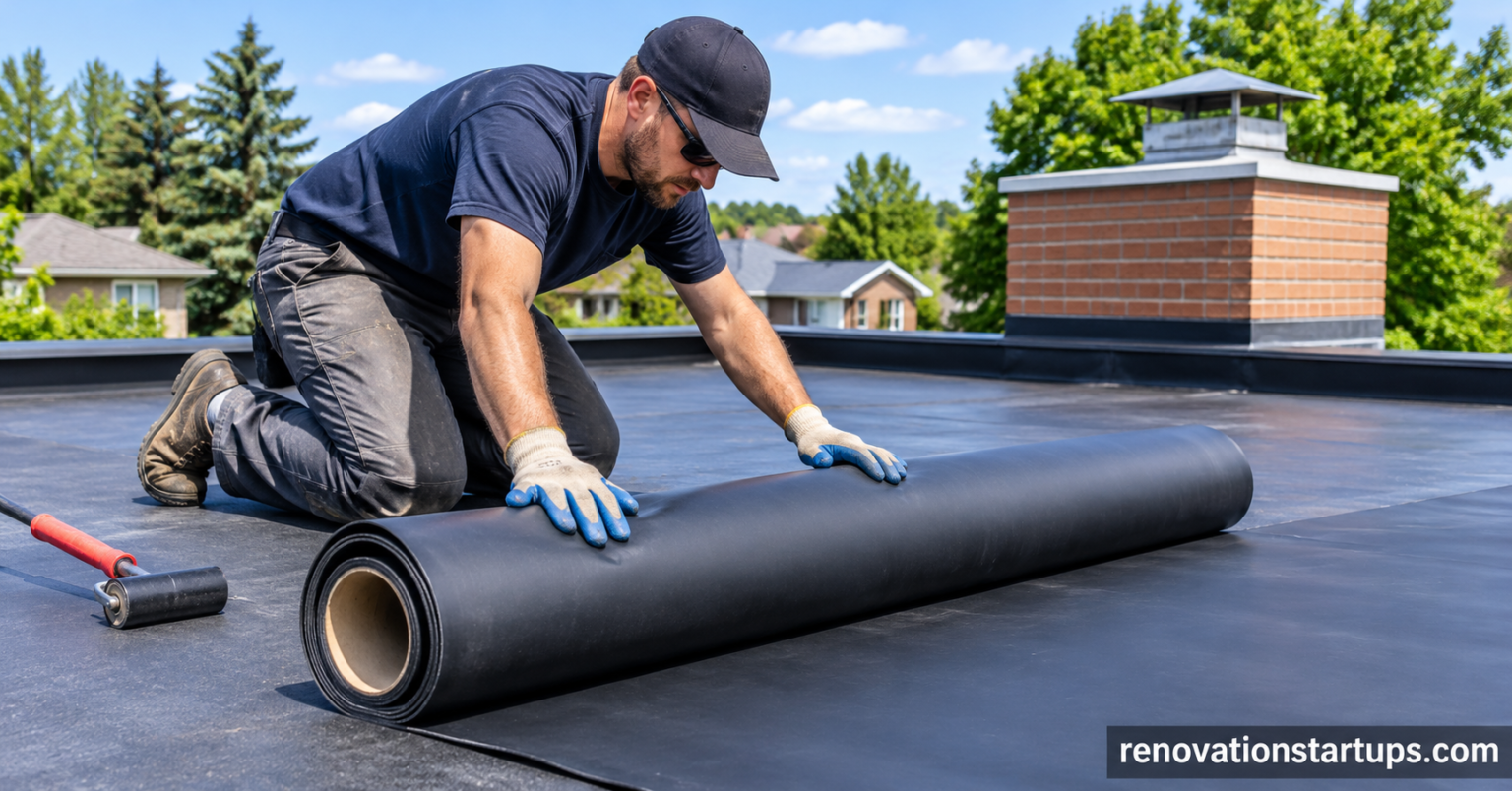
An EPDM rubber roof covers a building with one sheet of ethylene propylene diene monomer, a synthetic rubber membrane that crews roll across a flat roof or low-slope roof. The sheet acts as one waterproof layer, not many stacked layers. That makes single-ply membrane roofing easier to inspect and repair.
What Is an EPDM Rubber Roof?
As a rubber roofing system, EPDM differs from thermoplastic membranes because the EPDM membrane is true rubber, so heat does not reshape it. Installers match membrane thickness to the job, from a 60-mil membrane to a heavy-gauge membrane for busy commercial roofs. Some products add a reinforced membrane with an internal fabric layer.
How Do Black and White EPDM Membranes Differ?
A black EPDM membrane absorbs sunlight, while a white EPDM membrane reflects more of it. That color choice changes heat absorption at the roof surface and the cooling demand underneath. One Roofing Company offers white sheets where energy efficiency matters.
Black sheets remain common because EPDM has a long record in commercial roofing. Owners who care about solar reflectivity ask about a white sheet or a reflective coating instead. We suggest requesting the manufacturer’s reflectivity data, not judging by color.
Why Does EPDM Suit the Las Vegas Desert Climate?
EPDM suits the Las Vegas desert climate because rubber keeps its flexibility through hot afternoons and cool nights. Roofing Las Vegas notes afternoon highs above 110°F in Southern Nevada. The membrane offers ozone resistance and UV resistance, which slow surface cracking.
The Mojave Desert adds extreme summer heat, high-desert UV exposure, and a monsoon season that can bring flash floods across the Las Vegas Valley. One Roofing Company credits the membrane with high wind uplift resistance during those storms. Drainage matters as much as material.
How Does Thermal Shock Affect a Flat Roof?
Thermal shock happens when a roof heats and cools fast enough to stress its materials. Rigid membranes can split at seams during this thermal cycling, while rubber absorbs the movement through elasticity. Roofing Pro describes diurnal temperature swings as the main stress on low-slope roofs in Henderson, NV.
Daily expansion and contraction wears at every joint, and repeated cycles cause membrane fatigue. In northern Nevada, Reno Roofing points to cold-weather flexibility during freeze-thaw cycles as the bigger test. Tensile strength adds a margin against tearing.
What Installation Methods Do Contractors Use?
Contractors install EPDM three ways: fully adhered, mechanically fastened, or ballasted with stone. Crews glue a fully adhered sheet down with bonding adhesive, screw a mechanically fastened sheet to the deck, and rest a ballasted sheet under loose stone. One Roofing Company lists all three methods on its EPDM page.
Mountain Valley Roofing calls single-ply systems a lightweight membrane that limits structural load, which matters when ballast adds weight. Re-roofing over an existing roof saves time when the old system is sound. Failed roofs need tear-off and disposal, layer-by-layer removal, or a full roof replacement.
What Happens During an EPDM Installation?
A typical installation starts with a roof assessment, moves to surface preparation, and ends with the membrane and finishing details. Reno Roofing lists five steps: inspection, estimate, material selection, installation, and final inspection with cleanup. Each step offers a checkpoint.
Crews need a clean, dry, flat deck, so they handle deck inspection and sheathing/decking repair first. When energy code compliance requires it, they add polyiso insulation boards, then finish with a magnetic nail sweep and site cleanup. Ask who pulls the building permit, because Reno Roofing says the City of Reno requires one for roof replacement.
How Do Seams Hold an EPDM Roof Together?
Seams join separate sheets, so they decide how well the roof sheds water. Contractors join sheets with seam tape, which creates taped seams, or with liquid seam adhesive after they clean the edges with seam primer. Roofing Las Vegas describes seam vulcanization, where primer and tape produce chemically fused sheets.
Roofing Las Vegas says fusing prevents water creep along the joint. Unlike TPO and PVC, EPDM does not use heat-welded seams. Ask every contractor which seam method they use.
What Do Flashing Details Protect?
Flashing details seal the places where the membrane meets vents, walls, and equipment. Those spots include rooftop penetrations, equipment curbs, and parapet transitions, and they leak first when crews rush them. One Roofing Company names termination points at edges, drains, and penetrations as the usual trouble spots.
Good crews wrap vents with pipe boots, cover inside corners with reinforced corner patches, and finish the perimeter flashing, edge metal, scuppers, and drain boots. Roofing Las Vegas lists custom flashing details, and Reno Roofing lists edge metal, scuppers, and drain boots in its scope. Photos of finished details reveal more than slogans.
What Problems Can an EPDM Rubber Roof Develop?
Most EPDM problems start at seams and edges, not mid-sheet. Seam lifting, seam failure, and membrane pulling away from the edge usually trace back to adhesion. One Roofing Company also lists membrane shrinkage at edges and flashing failure at penetrations among common repairs.
Roofing Las Vegas traces seam failure to outdated adhesives, improper priming, and standing water. Membrane punctures add a second cause, and delamination appears where a bond never formed fully. Ask contractors to name the cause of any past leak.
How Does Water Damage Spread From a Small Leak?
Water that enters through a small defect travels under the membrane and soaks the insulation. Ponding water and poor drainage speed that process, and blistering signals trapped moisture. Roofing Pro recommends slope adjustment or roof drains to prevent long-term ponding.
Unchecked water intrusion produces recurring leaks, dry rot, and damaged decking and insulation that cost more than the original defect. Storm damage can open the same weak spots in one afternoon. Reno Roofing warns that delay raises repair costs later.
How Do Contractors Repair an EPDM Roof?
Repair starts with finding the source, then bonding compatible patches over the cleaned defect. One Roofing Company says EPDM is repair-friendly and that patches hold when crews apply them correctly. Ask whether a contractor handles EPDM roof repair or only replacement.
Related services include leak repair, emergency roof repair, flat roof repair, and flat and foam roof repairs, plus roof inspection and roof maintenance. Roof coating can restore a worn surface, and new roof installation or roof replacement applies when repair no longer makes sense. The brand sections below show which services each website confirms.
Can You Coat an EPDM Rubber Roof to Cut Heat?
Yes, a cool roof coating can cover an EPDM sheet and reflect sunlight. Roofing Las Vegas says an elastomeric coating or a silicone cool-roof coating reflects up to 85% of solar radiation, which supports cooling load reduction. RoofAid USA mentions an acrylic coating too.
Roofing Las Vegas offers a high-albedo silicone topcoat that turns black EPDM into a cool roof, and it uses a reflective top coat in its EPDM work. Coyne Roofing notes clean rainwater runoff, which suits green roofing projects, and RoofAid USA calls the membrane 100% recyclable. Ask for the coating maker’s written approval.
How Does EPDM Compare With TPO, PVC, and Other Roofing Systems?
EPDM, TPO, and PVC are all single-ply membranes, but they differ in material and seam method. Mountain Valley Roofing installs all three on commercial roofs and states a typical EPDM lifespan of 25 to 35 years. Compare that contractor figure with the manufacturer’s warranty term.
Other systems include modified bitumen, built-up roofing, torch-down roofing, metal roofing, and roll roofing. RoofAid USA credits EPDM with hail resistance and fire resistance, while Roofing Las Vegas credits puncture resistance and foot-traffic durability. Request test data for any of these claims.
What Strengths Do Property Owners Value Most?
Owners value waterproofing performance first, because a watertight barrier protects everything below the deck. Mountain Valley Roofing credits fully adhered systems with seamless protection against moisture, and Reno Roofing links sealed seams to long-term leak resistance. Both depend on installation quality.
Roofing Pro lists low maintenance among its benefits, and Reno Roofing says properly installed systems often exceed 30 years, a long service life that still needs upkeep. Roofing Las Vegas highlights chemical stability under sun exposure. Verify each claim.
Which Buildings Suit an EPDM Rubber Roof Best?
EPDM suits warehouses, retail centers, industrial facilities, and storage facilities where durability matters more than appearance. Mountain Valley Roofing names the first three, and One Roofing Company adds storage facilities. Roofing Pro and RoofAid USA describe flat and low-slope uses too.
Homes can use it too, mostly on residential flat decks such as additions, porches, and low-slope sections beside a pitched roof. One Roofing Company says it assesses residential flat sections case by case. Steep roofs need a different material.
What Credentials Should an EPDM Contractor Hold?
A Nevada roofing contractor needs a state license, so verify the Nevada contractor license through the Nevada State Contractors Board before you sign anything. Ask whether the company is licensed, bonded and insured. One Roofing Company publishes license number NV C15 #77754 in its footer.
Manufacturer certification means the maker has trained and approved the installer, and Reno Roofing says it holds manufacturer certifications for EPDM systems. Roofing Pro lists factory-trained technicians, and Reno Roofing cites a manufacturer material warranty plus a workmanship warranty. Ask for both warranties in writing and confirm code compliance.
Which Contractors Mention EPDM, and What Do Their Websites Confirm?
Each brand offers the services listed on its own website, and we name only services those pages confirm. The brands below all mention EPDM in Nevada. Call each company to confirm current services and service area.
Which Brands Serve Las Vegas and Henderson, NV?
One Roofing Company works in Henderson, NV, Summerlin, and Boulder City, and its page confirms EPDM installation, EPDM repair, and re-roofing over sound existing roofs. Roofing Las Vegas lists seam repairs and cool-roof coatings, while Roofing Pro lists precision seaming, flat roof repair, and roof coating. Both state they are referral services, not contractors.
One Roofing Company’s menu adds flat and foam roof repairs, roof leak repair, and roof coating systems. Roofing Las Vegas and Roofing Pro both list emergency roof repair and storm damage repair. Ask who will perform the work.
Which Brands Serve Northern Nevada?
Reno Roofing, Coyne Roofing, and Mountain Valley Roofing serve northern Nevada. Reno Roofing confirms EPDM installation with removal of old roofing, deck repair, and insulation, while Coyne Roofing confirms EPDM installation, rubber roofing repair, and flat roof repair. Mountain Valley Roofing confirms commercial single-ply installation of TPO, PVC, and EPDM.
Coyne Roofing displays Versico, CertainTeed, and GAF logos and says its roofers are CertainTeed certified installers. Reno Roofing’s menu also lists modified bitumen, roll roofing, and PVC membrane work. RoofAid USA confirms EPDM installation and repair but lists locations in Indiana, Ohio, and Tennessee, so treat it as non-local.
What Questions Do Readers Ask About EPDM Roofing?
How Long Does an EPDM Rubber Roof Last?
Contractor pages give different ranges: Roofing Las Vegas says 25 to 30 years, Mountain Valley Roofing says 25 to 35, and Reno Roofing says 30 or more. Installation quality and upkeep drive the difference. Ask for the manufacturer warranty term instead.
Is an EPDM Rubber Roof Worth the Cost?
It is worth the cost when the roof is flat, the climate is hot, and the contractor details seams and flashing correctly. Cost depends on roof size, membrane thickness, insulation, access, and tear-off. Reno Roofing names insulation needs, access, and roof complexity as its price drivers.
Do Contractors Repair EPDM or Only Replace It?
Several contractors repair it. Coyne Roofing, One Roofing Company, and RoofAid USA each mention EPDM repair. Check each service list.
Why Should You Start Your Search on This Site?
This site compares what each provider’s website confirms, which credentials to verify, and which questions to ask. Use that information to shortlist two or three providers, then confirm services, license numbers, and warranty terms. Start with the Las Vegas and Henderson, NV sections above, and request a written scope before you decide.
