
Romanian words come mostly from Latin, layered with Slavic vocabulary and smaller borrowings from Turkish, Hungarian and French. If you know a little Spanish or Italian, you will recognize plenty of them. Start with greetings, numbers and food terms, and you can handle most everyday situations.
Ever heard someone say mulțumesc and wondered what on earth it meant? Stick with me. By the end, you will know that word and a good few more, and you will see why Romanian feels like a cousin you have never met.
What are Romanian words and where do they come from?
Romanian is an Eastern Romance language with roughly 24 million native speakers. It is an official language in Romania and Moldova, and you will hear it in Canadian cities such as Toronto and Montréal, where Romanian-speaking communities have settled over the decades.
The story starts when Rome conquered Dacia, the region that covers much of present-day Romania, in the early second century. Latin mixed with local speech, then spent more than a thousand years cut off from the rest of the Romance world. That isolation explains why the vocabulary has three distinct layers.
The Latin core
Most basic vocabulary is inherited from Latin. Apă (water) comes from aqua, lună (moon) from luna, and pâine (bread) from panis. Put om (man) beside the Latin homo and the link is hard to miss.
Then there is dor, a word for deep longing that Romanians treat almost as a national feeling. It is often traced to Latin dolor. English has no single word for it, and I think that is a loss.
The Slavic layer
Centuries of contact with Slavic neighbours left a deep mark. Prieten (friend), iubire (love) and even da (yes) are Slavic in origin. That surprises many learners. A Romance language that says “da” like Russian? Yes, really.
Borrowings from Turkish, Hungarian and French
Papuc (slipper) came from Turkish and oraș (city) from Hungarian. French added birou (office) during the nineteenth century, when Romanian speakers looked westward for modern vocabulary.
How do you pronounce Romanian words?
Good news. Most Romanian words are read exactly as they are written, so once you learn a handful of sounds, spelling stops being a trap. Five characters need your attention:
- ă sounds like the a in “about”
- â and î share one sound, a tight “uh” made at the back of the mouth
- ș is “sh”, as in șapte (seven)
- ț is “ts”, as in the middle of mulțumesc
- c before e or i is “ch”, so cer (sky) sounds like “chair”
Try mulțumesc slowly: mool-tsoo-MESK. Romanian vowels are short and clean, so don’t glide them the way English does.
Please don’t skip the diacritics. Mama and mamă are different forms, and leaving the marks off looks careless to a native reader. In my view, pronunciation is the easy part of Romanian. Grammar is where you will earn your keep.
Which Romanian words should beginners learn first?
Ask yourself what you will actually say this week. A trip, a family visit, a chat with a neighbour? Start there, and let your real life choose your vocabulary.
Greetings and politeness
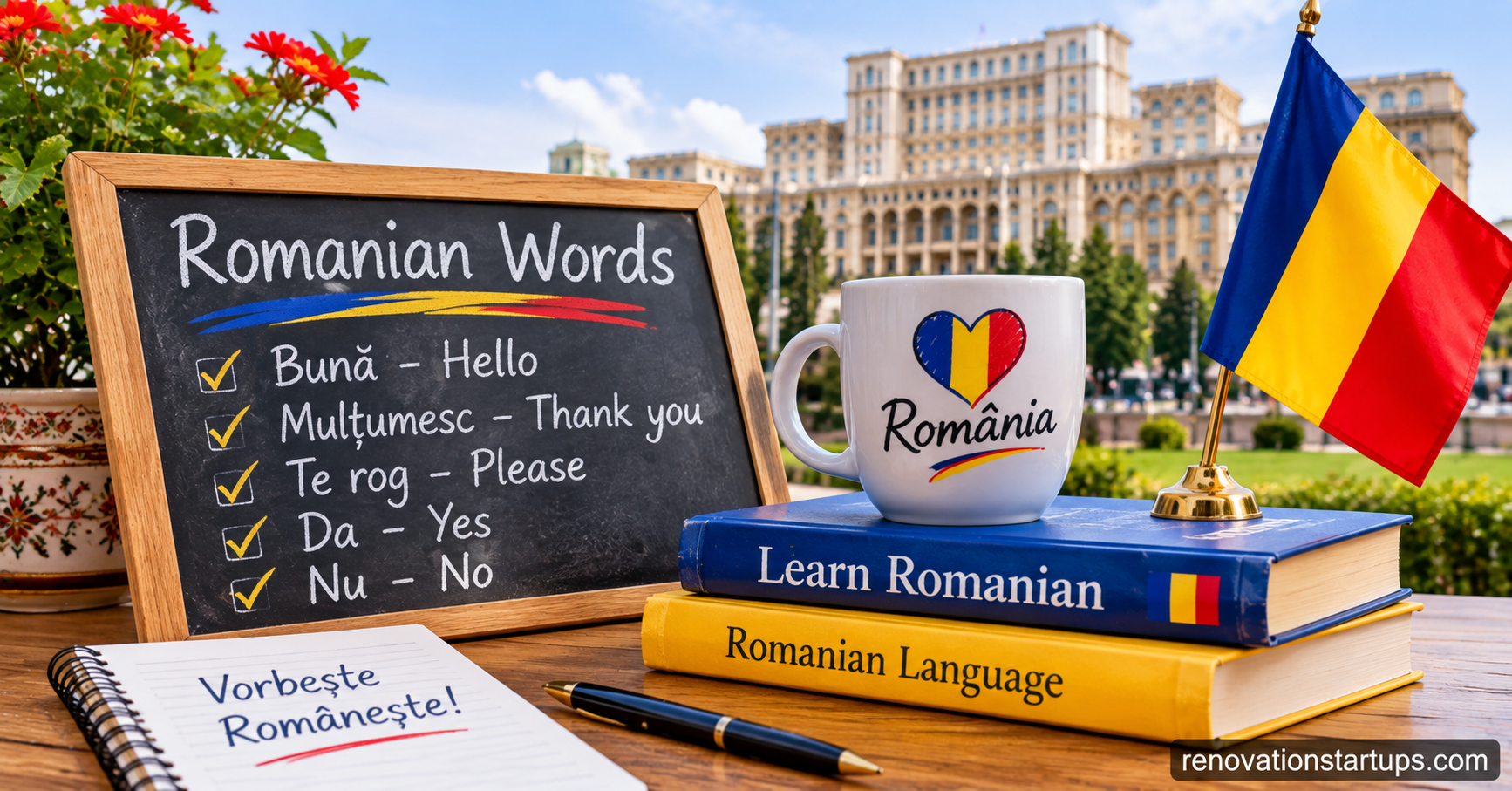
Bună ziua means “good day,” salut is a casual “hi,” mulțumesc is “thank you” and vă rog is “please.” Romanian uses two forms of “you.” Use dumneavoastră with strangers and elders, and tu with friends and children. If you are unsure, go formal. Nobody minds.
Food and drink
Apă (water), pâine (bread), cafea (coffee) and bere (beer) will carry you through any café. Try “O cafea, vă rog,” which means “one coffee, please.” Then look out for sarmale, cabbage rolls that appear at nearly every family celebration, and mămăligă, a cornmeal porridge that tastes far better than it sounds.
Numbers and days
Count to ten: unu, doi, trei, patru, cinci, șase, șapte, opt, nouă, zece. The days run luni, marți, miercuri, joi, vineri, sâmbătă, duminică. Chant them aloud. Rhythm sticks better than a written list.
Together, these Romanian words give you a working base of about fifty terms, enough for a polite, friendly exchange. One tip: learn each word inside a short sentence rather than alone. Aș vrea o apă (“I would like a water”) teaches you the word and a useful pattern at once.
How is Romanian different from Italian and Spanish?
Compare “bread”: pâine in Romanian, pane in Italian, pan in Spanish. Same Latin root, different journey.
Romanian also does something its cousins do not. It attaches the article to the end of the noun. Casă (house) becomes casa (the house), and om becomes omul (the man). It also keeps case endings that Spanish and Italian dropped long ago, so a word can change shape depending on its job in the sentence.
Beware of false friends too. Pensie means a retirement pension, not a guest house. Learn that one early and you will save yourself an awkward moment.
Can you learn Romanian words in Canada?
Yes, and you have more options than you might think. Many public libraries across Canada offer free language-learning apps with a library card, so check yours before paying for anything. Cultural associations and community centres in larger cities often run conversation groups and children’s classes.
Heritage speakers have an edge here. If your grandparents spoke Romanian at home, you probably absorbed more than you realize, and hearing those sounds again can bring it back quickly. If you have no family connection, find a patient Romanian-speaking friend who will correct you over coffee. Nothing beats that. Statistics Canada publishes language data if you are curious how many Canadians speak Romanian at home.
FAQ
What are the most common Romanian words?
Da (yes), nu (no), mulțumesc (thank you), bună (hello) and vă rog (please) top most beginner lists. Learn these five first and you can already be polite in almost any situation.
Is Romanian hard for English speakers to learn?
Moderately. Pronunciation is regular, and Latin roots help if you know French or Spanish. Genders, cases and verb forms take longer. Plan for steady practice over months, not days.
How do you say thank you in Romanian?
Say mulțumesc. For “you’re welcome,” say cu plăcere. Add vă rog when you ask for something, and you will sound like someone who cares about the language.
Is Romanian the same as Moldovan?
Linguists treat them as the same language. In Moldova, the name “Moldovan” is used in some official contexts, but the standard written forms are essentially identical.
