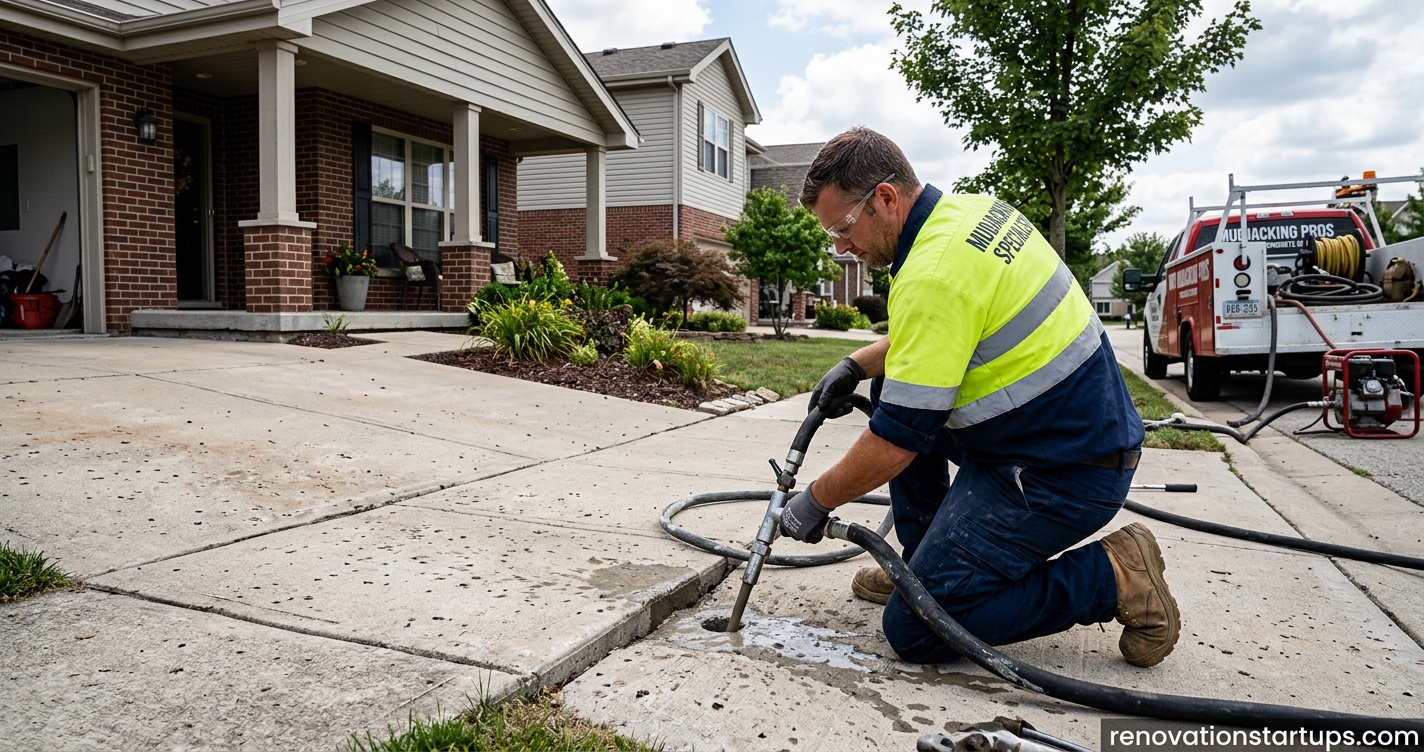
Mudjacking lifts a sunken concrete slab by pumping a cement-based slurry underneath it, filling the void left by eroded or settled soil. It’s a repair, not a replacement — the existing slab stays put while the ground beneath it gets built back up. Most residential jobs across Ontario, Alberta, and British Columbia run a few hundred to a couple thousand dollars and finish in an afternoon, often with one trailer-mounted pump handling two or three sunken slabs in a single visit.
What Is Mudjacking?
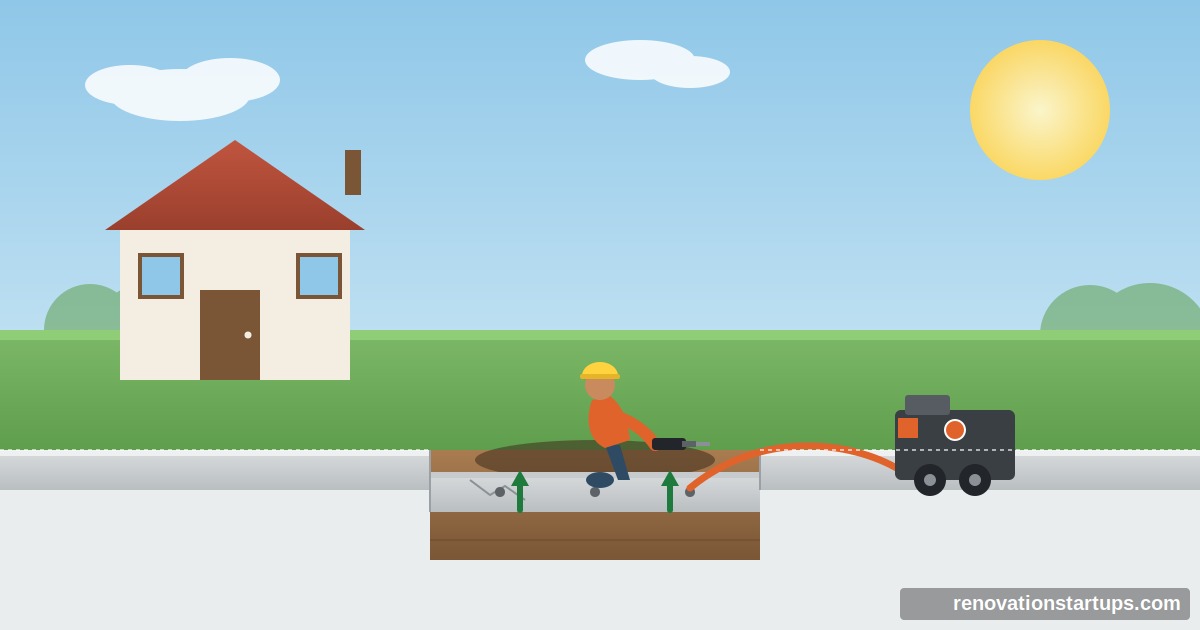
Mudjacking is a concrete levelling technique where a contractor drills small holes into a sunken slab and pumps a thick mixture of cement, sand or soil, and water through those holes into the ground below. As the mixture fills the empty pockets under the concrete, hydraulic pressure pushes the slab back toward its original position. The term dates back close to a hundred years, and the process itself has barely changed — only the pumps and mix ratios have gotten more refined.
Homeowners sometimes hear it called slabjacking or concrete raising. Same process, different name, and contractors in different provinces tend to favour one term over the other. The slurry itself usually mixes about one part cement to five or six parts sand or fine soil, thinned with just enough water to move through a hose without separating.
How Does Mudjacking Work?
A typical job moves through a handful of predictable stages, and a crew that skips steps usually leaves you with an uneven patch instead of a level driveway.
Step 1: Inspection and Marking
The technician checks the slab’s slope, taps around to listen for hollow spots, and marks drill points roughly 30 to 45 centimetres apart.
Step 2: Drilling
Holes between 2.5 and 5 centimetres wide go through the concrete at the marked points — enough to fit a pump nozzle, not so many that the slab looks perforated afterward.
Step 3: Pumping the Slurry
A hydraulic pump forces the mixture through the holes in stages, lifting one section before moving to the next so the surface rises evenly instead of tilting. A gauge on the pump tells the operator how much pressure is building underground, which is how an experienced crew avoids over-lifting a corner and cracking the slab.
Step 4: Levelling and Patching
Once a level or laser tool confirms the slab has reached the right height, the crew stops pumping, patches the holes with matching concrete, and cleans the area.
Most homes see this finished within three to five hours, and the surface is usually ready for foot traffic later the same day.
What Causes Concrete to Sink?
Concrete doesn’t sink on its own; the ground underneath it moves first. In our experience assessing sunken driveways, the culprit is almost always one of these:
- Soil erosion from poor drainage or a downspout dumping water right beside the slab
- Freeze-thaw cycling, which is rough on slabs across colder provinces where the ground heaves in winter and settles unevenly by spring
- Loose or poorly compacted fill soil left over from the original build
- Tree roots pulling moisture out of the soil beneath a slab, leaving it dry and prone to collapse
Driveways poured over old builder’s fill tend to be especially prone to this, since compaction standards used decades ago were looser than what’s expected on a new build site today. A slab that rocks when you walk across it, or sounds hollow when tapped, has voids underneath. That’s precisely the problem this repair is built to fix.
How Much Does Mudjacking Cost?
Pricing runs by square footage, and most contractors quote somewhere between 40 and 100 dollars CAD per square foot for smaller jobs, with larger driveways working out cheaper per square foot since setup costs stay fixed regardless of size.
A single sunken sidewalk panel might run 400 to 900 dollars CAD. A driveway section with significant settlement can land anywhere from 1,500 to 4,000 dollars CAD. Compare that to tearing out and repouring the same driveway, which frequently exceeds 6,000 dollars CAD once demolition and disposal are factored in, and the appeal becomes obvious.
Get a written quote before agreeing to anything, and ask whether drainage correction is included. A lifted slab with the same drainage problem will likely sink again within a few years. Some contractors also add a flat call-out fee for rural addresses, so ask upfront.
Mudjacking vs. Polyurethane Foam Levelling: Which One Should You Choose?
Polyurethane foam injection is the newer alternative, and it competes directly with the slurry method for the same repair jobs. Foam costs more upfront, often 90 to 250 dollars CAD per square foot, but it weighs a fraction of what cement slurry weighs, cures within roughly 20 minutes, and doesn’t erode the way a soil-based mix can once water finds its way underneath again.
Slabjacking still wins on upfront price, and for a low-traffic sidewalk or patio where a repair lasting five to eight years is perfectly reasonable, spending less makes sense. Foam earns its higher price on driveways carrying vehicles daily, or in spots where drainage issues can’t be fully resolved and moisture exposure stays ongoing. On the environmental side, the cement-and-soil slurry uses fairly ordinary, locally sourced materials, while foam relies on a manufactured two-part chemical product, which matters to homeowners weighing that trade-off.
Neither option is universally right for every property. The choice depends on budget, how long you plan to stay in the home, and how exposed the slab is to water.
How Long Does Mudjacking Last?
A properly done concrete-levelling repair typically holds for five to eight years, sometimes longer if drainage around the slab gets fixed at the same time. The slurry itself isn’t waterproof, so if water keeps finding its way underneath, it can wash the material out gradually, and the settlement returns.
Sealing cracks promptly, redirecting downspouts away from the repaired area, and keeping heavy equipment off a freshly lifted slab all extend the repair’s working life noticeably.
FAQ
Is mudjacking worth it?
For a structurally sound slab that’s simply sunken, generally yes; it costs a fraction of replacement and solves the tripping hazard right away. It’s a harder sell on a slab that’s cracked into multiple pieces or resting on soil that’s still actively shifting.
How long does concrete levelling take?
Most residential jobs finish in three to five hours, start to finish, including hole patching and cleanup.
Can you mudjack a foundation?
Some foundation slabs can be lifted this way, but foundation settlement is more complicated than a driveway or patio, and it deserves a structural assessment first, not a quick quote over the phone.
Does the process fix cracks?
No. It lifts and levels the slab; existing cracks still need to be sealed or patched separately once the lift is finished.
Is the process messy or noisy?
There’s some dust from drilling and a bit of grey slurry residue around the holes afterward, but most crews clean up the same day. Noise is comparable to a masonry drill — audible, but not disruptive enough to bother neighbours for more than a few hours.
