
TPO roofing is a single-ply roofing membrane that covers commercial roofing on flat and low-slope roofing decks. Michigan owners choose it for its white reflective surface and welded joints. This guide explains the system, its weak points, and how to pick a provider.
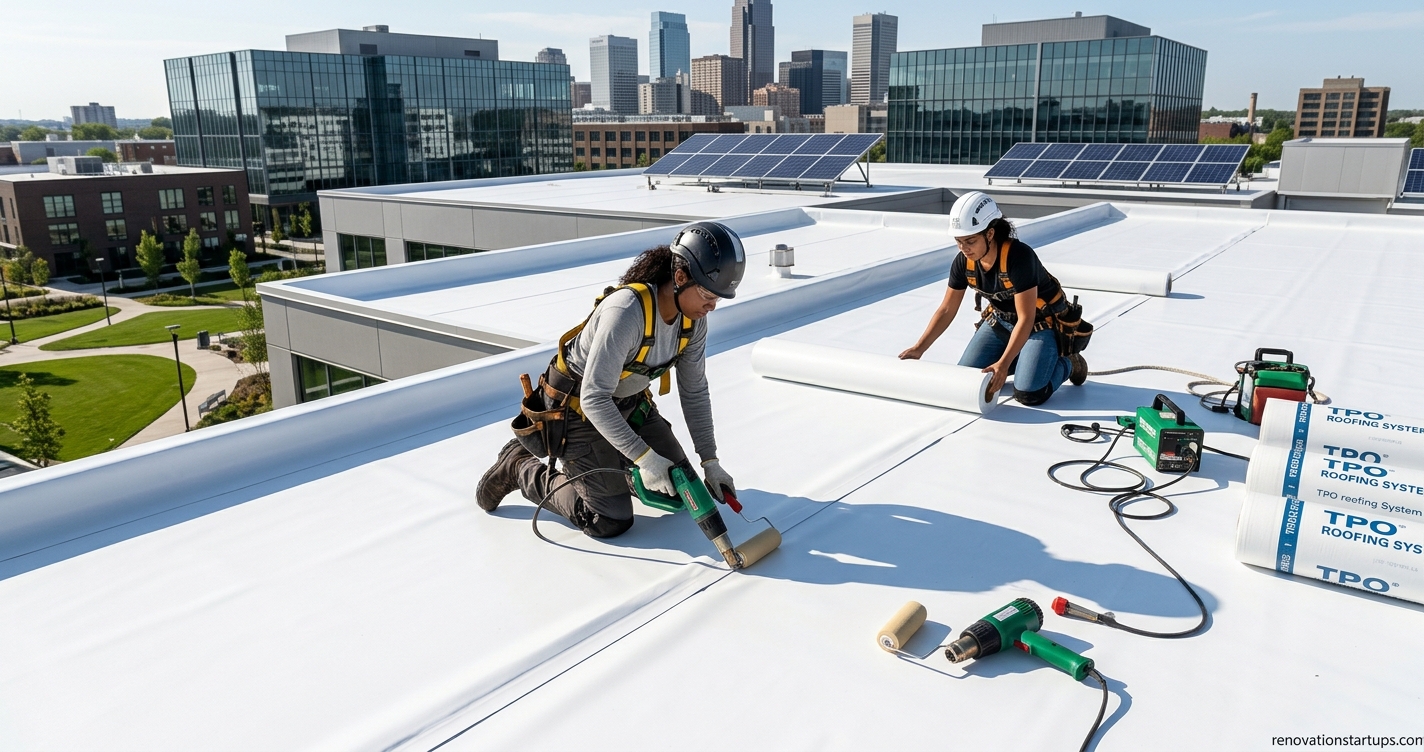
Crews roll a TPO membrane, a sheet of thermoplastic polyolefin (TPO), across the building and fuse the sheets with heat-welded seams. Those welds decide how long the roof lasts more than the sheet itself does. Each section below shows where that detail matters.
What Is TPO Roofing and Why Do Michigan Commercial Buildings Use It?
Owners pick TPO because it pairs solar reflectivity with lightweight roofing that loads the structure less. Among flat roofing systems, it competes mainly with EPDM roofing, PVC roofing, and modified bitumen. All four work, so climate, budget, and roof traffic decide the winner.
A cool roof reflects sunlight, and U.S. Department of Energy cool roof research reports that a reflective roof can stay more than 50°F cooler than a dark one under the same conditions. That gap supports cool-roof energy savings in large warehouses and offices. Actual results still depend on insulation and mechanical equipment, so treat energy-efficient roofing as one factor among several.
What Parts Make Up a TPO Roofing System?
A TPO roofing system stacks three layers. The roof deck carries the load, the insulation layer adds R-value, and the TPO membrane keeps water out. Flashing seals the edges and every opening.
Crews attach the sheet with membrane fastening over tapered insulation, which slopes toward the drains and scuppers. Around HVAC curbs, skylights and hatches, and other roof penetrations, they cut flashing membrane or prefabricated boots to fit. Awkward details need custom-fabricated corners, and heavy-traffic routes need walkway pads.
Which Is Better: TPO vs. EPDM vs. PVC for Commercial Roofs?
The TPO vs. EPDM vs. PVC decision turns on color, seam method, and what sits on the roof. TPO and PVC both weld and reflect heat, while EPDM stays black and absorbs it. Miami Flat Roofing & Replacement says EPDM suits small roofs and carports, and TPO suits most large flat roofs.
Metal roofing enters the comparison on buildings that need a different profile. A roof-over system sometimes lets owners keep the old layers and add a new membrane on top, though the existing roof substrate must stay dry and sound. Ask for a roof assessment before assuming either path.
What Problems Affect TPO Roofing on Michigan Commercial Buildings?
Most TPO trouble starts at joints and openings, not across the open field. Seam failures, punctures and tears, and flashing fatigue cause most persistent roof leaks. Slow UV degradation and ponding water add stress over time.
Aging shows first on the surface through chalking, crazing, and a brittle membrane that develops membrane cracking. Large flat roofs also show blistering and membrane shrinkage after years of movement. Sacramento Signature Roofing treats fastener back-out as a sign that spot repairs will not hold.
What Causes Seam Failures and Leaks?
Seam failures start when welds run too cool, too fast, or over dirty material. Glued seams fail sooner than welded ones, a point Miami Flat Roofing & Replacement stresses for hot climates. Water then follows the joint inward and causes water intrusion that spreads under the surface.
Saturated insulation is the costly stage, because waterlogged board loses R-value. Sacramento Signature Roofing recommends moisture mapping because water travels sideways beneath the surface. Without it, a crew may patch the visible stain and miss the entry point.
How Does Michigan Weather Stress a TPO Roof?
Michigan roofs face temperature swings, extreme weather, and UV exposure within the same year. Thermal expansion and contraction tugs on the welds daily, and heat cycling repeats that stress across seasons. Wind uplift, wind loads, and wind-driven rain test the edges and fasteners.
Cold complicates repairs too, because cold-weather welding demands special technique and dry deck conditions. Sacramento Signature Roofing sets 40°F ambient temperature as the floor for good bond strength, which rules out many Michigan winter days. Condensation under a patch also weakens adhesion, so crews wait for fair weather.
How Do Contractors Handle TPO Roof Repair?
Good TPO roof repair follows a fixed order: locate the water, run membrane cleaning, complete damage removal, and weld a matching patch. Skipping the diagnosis leads to repeat leaks. A crew that treats only the stain returns to the same spot, so lasting leak repair starts with the source.
Heat-welding patches for punctures use TPO of matching thickness, and patch sizing matters because Sacramento Signature Roofing’s guide extends each patch at least 3 inches past the damage. The same guide sets hot-air welding at 1,000–1,100°F for a weld bead about 1 inch wide. All Seasons Roofing describes the same puncture repair with primer application before the weld.
What Does a Complete Repair Include?
A complete repair starts with rewelding separated seams, then covers the joint with a cover strip or reinforcement strip. A technician finishes the weld with a calibrated hot-air welder and edge sealant. The job ends with weld probing, moisture verification, and a post-repair inspection.
Flashing and penetration repairs replace worn parts and add stainless termination bars and high-compression screws to resist lift. A roof coating, such as an elastomeric topcoat, adds UV protection to worn surfaces but cannot close open seams. Roof restoration therefore suits aging roofs with sound joints, as All Seasons Roofing explains.
Can You Patch a TPO Roof Yourself?
A temporary patch can stop a drip in an emergency, but it does not replace a welded repair. A solvent-based sealant and tape form a weaker bond than a true weld. Sacramento Signature Roofing warns that such patches often void the manufacturer warranty.
All Seasons Roofing advises commercial owners against DIY kits, because a lasting bond needs the right temperature and speed. Contractors who use manufacturer-approved materials also protect warranty coverage. Call a professional for emergency roof repair when water enters the building.
Is It Better to Repair or Replace a TPO Roof?
Repair vs. replacement depends on age, damage spread, and moisture. All Seasons Roofing favors repair under 15 years and replacement once a roof nears its warranted lifespan past 20 years. Sacramento Signature Roofing adds that damage across more than 25 percent of the membrane points toward replacement.
A partial roof replacement handles one failed zone, and full roof replacement suits widespread damage or a roof near the end of service life. Miami Flat Roofing & Replacement describes tear-off, a decking assessment of plywood decking, and insulation installation before the new sheet goes down. Insist on a written scope of work that names each step, whether you plan flat roof replacement or TPO roofing installation.
How Do You Inspect and Maintain a TPO Roof?
A proactive maintenance plan catches small defects early. Schedule spring and fall inspections and a post-storm check after hail and wind damage. All Seasons Roofing recommends that twice-yearly rhythm.
Drain cleaning and debris control prevent clogged drains and scuppers, which cause ponding water. Foot traffic management limits foot-traffic damage, and a sweep after storms removes storm debris before it punctures the sheet. These habits support service life extension toward a 20–30 year lifespan, the range Miami Flat Roofing & Replacement and Sacramento Signature Roofing both cite.
What Tools Reveal Hidden Moisture?
Inspectors trace hidden water with an infrared scan, a moisture probe, or capacitance scanning. Each tool finds waterlogged board that the eye cannot see. Sacramento Signature Roofing lists infrared and capacitance tools as its first diagnostic step.
During a maintenance visit, technicians also perform probing for wet insulation near drains and HVAC curbs. That preventative maintenance fits into normal flat roof maintenance schedules and a written roof inspection report. A final inspection closes the visit and documents the roof’s condition.
What Should You Look For in a TPO Roofing Provider?
Look for manufacturer training credentials, a documented safety program, and proof that the company is licensed and insured. Ask who performs the welds and which equipment they use. Sacramento Signature Roofing’s guide suggests a workmanship warranty of at least five years.
Read every quote line by line, because a detailed scope separates real estimates from vague ones. Confirm building permits, manufacturer warranty terms, and safe roof access plans before work starts. Top Florida Roofing tells owners to verify licenses at the source and to avoid electrical hazards and unstable areas after storms.
Which Questions Should You Ask Before Hiring?
Ask who welds, which membrane thickness they install, how they detail flashing, and what warranty coverage excludes. Specific answers signal real TPO experience. Vague answers signal a crew that cuts corners.
Miami Flat Roofing & Replacement installs 60 mil TPO and says it outlasts 45 mil TPO under heat cycling. The same page says a thinner sheet with welded joints beats a thicker one with glued seams. It also limits itself to products with Miami-Dade NOA approval, a Florida requirement, so ask which approvals apply in Michigan.
Which Brands Offer These Services?
Five brands appear in this guide, and each offers the services listed on its own website. All Seasons Roofing lists commercial roof installation, repair, replacement, and 24/7 emergency service. Sacramento Signature Roofing lists TPO roof installation, TPO roof repair, and re-roofing.
Miami Flat Roofing & Replacement lists commercial TPO roofing, flat roof repair, and roof coating, while Top Florida Roofing lists storm damage repair and TPO and modified bitumen flat systems. Miami Roof-Tech lists new roofs, re-roofs, and repairs, and it names GAF among the brands it installs. None of these pages mentions Michigan, so confirm each company’s service area first.
Why Is This Site the Easiest Way to Find a TPO Roofing Provider?
This site collects the services each brand confirms on its own website, so you can compare providers in one place. That saves you from reading five separate pages and sorting marketing from facts. You then contact only the companies that match your building.
Start with the brand list, then check credentials, request a written scope of work, and confirm the service area. Compare answers on membrane thickness, workmanship warranty, and repair method. A short list of qualified providers beats a long list of unchecked names.
What Are the Most Common TPO Roofing Questions?
These short answers cover what owners ask most before they call a contractor. Each one reflects what the brand websites state. Use them as a checklist during your first conversation.
How Long Does a TPO Roof Last?
A well-installed TPO roof lasts 20 to 30 years, according to Miami Flat Roofing & Replacement and Sacramento Signature Roofing. Weld quality and maintenance push a roof toward the upper end. Regular checks catch problems before they spread.
Can You Repair TPO in Cold or Wet Weather?
It is difficult, and All Seasons Roofing says wet surfaces and cold temperatures both weaken a weld. Sacramento Signature Roofing wants a dry deck above 40°F. Schedule non-urgent work for fair weather and call for emergency roof repair only when water enters.
Does a Repair Hurt Energy Savings?
No, because Sacramento Signature Roofing states that white TPO patches match the original reflectivity and keep Energy Star performance. Ask the contractor to use matching white material. Mismatched patches would change how the surface reflects heat.
How Long Does a Welded Repair Last?
A correct weld creates a fusion bond, and All Seasons Roofing says the patch becomes a monolithic bond with the surrounding sheet. Sacramento Signature Roofing says a well-welded patch can last as long as the original roof. Poor welds often fail much sooner.
What Is the Next Step for Your TPO Roof?
Start by listing your building’s age, roof deck type, and any persistent roof leaks, then use the brand list on this site to contact providers that match. Ask each one for a written scope of work, proof they are licensed and insured, and warranty coverage details. Visit this site to compare the services each brand confirms, and choose a provider that answers your questions clearly before you sign anything.
