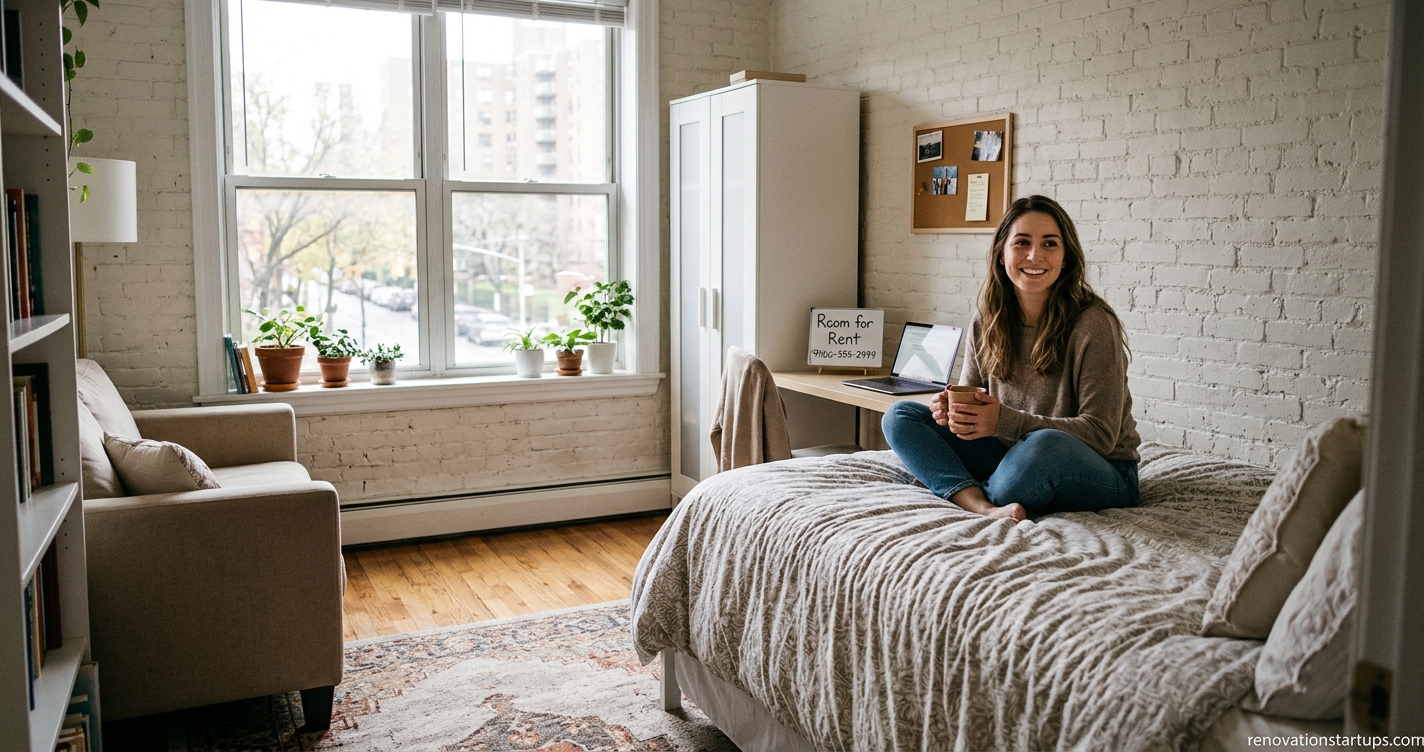
A room for rent in Canada is a private bedroom inside a shared house or apartment, where the kitchen, bathroom and living areas belong to everyone. Prices depend mostly on the city. Smaller Prairie cities often sit under $1,000 a month, while Toronto and Vancouver commonly pass that mark. Ask whether utilities are included before you say yes. That one question changes the real price more than most people expect.
What does a room for rent actually include?
You have scrolled the listings. “Bright room close to transit.” Sounds simple, right? It rarely is. Here is how the common types differ, and what each means for your daily life.
Room in a house
The owner often lives there too, and that matters legally (more on that below). You usually share a kitchen and one or two bathrooms. Rent tends to run lower than in an apartment. House rules, on the other hand, can be surprisingly strict.
Room in a shared apartment
Several people split one lease, or one tenant sublets a spare bedroom. Ask whose name is on the lease. If a roommate leaves, you could end up covering their share.
Basement room
Usually cheaper. Check ceiling height, natural light, heating and a window big enough to climb through in an emergency. Ask whether the space meets local building and fire codes. A damp smell is a red flag.
Co-living
Private bedrooms with shared lounges and kitchens, often priced as one bundle with internet and utilities. You pay more each month but skip the setup hassle.
How much does renting a room cost across Canada?
Official figures help here, because single rooms are poorly tracked. Recent Statistics Canada data put average asking rents for a two-bedroom apartment near $3,100 in Vancouver, $2,660 in Toronto, $1,900 in Calgary and Montréal, and $1,580 in Edmonton. Here is my shortcut: halve those numbers. That gives roughly $1,550, $1,330, $950 and $790 per person. Real rooms land above or below that depending on size, location and furnishing. Rents have eased across much of the country lately, though Toronto and Vancouver have started firming up.
Three things move the price the most: distance from rapid transit, whether the room has its own bathroom, and whether it comes furnished. A private ensuite often matters more than saving twenty minutes on the commute, though that trade-off is personal.
Where do you actually find a room for rent?
Start with online classifieds and rental platforms, then add campus housing boards if you study. Community groups and word of mouth work too, and I would not skip them. Some of the better rooms never reach a public listing. Set alerts for your city and budget, and reply within the hour, because popular rooms disappear fast. Timing matters as well. For a September start, begin searching between May and July.
Your first message matters. Say who you are, what you do, your move-in date and how long you plan to stay. Keep it to four or five lines. A landlord reading forty replies will remember the person who sounded organized and easy to live with.
What should you check before you pay anything?
Bring this list to every room for rent you visit, in person or by live video.
- The full monthly cost, including utilities and internet
- Whose name is on the lease
- House rules on guests, quiet hours and cleaning
- Working smoke and carbon monoxide alarms, plus a lock on your bedroom door
- Photos of any damage, emailed to the landlord on move-in day
- The notice period and deposit return terms
Do tenant rights apply when you rent a room?
It depends on your province, and on who you share with. In Ontario, for example, the Residential Tenancies Act generally does not cover you if you share a kitchen or bathroom with the owner or their immediate family. Share only with other tenants, and you are normally covered. Deposits differ too. Ontario allows a rent deposit of no more than one month, applied to your final month. British Columbia caps a security deposit at half a month’s rent. Alberta allows up to one month’s rent. Rent increases are capped yearly in several provinces, including Ontario and British Columbia, and notice must be in writing. Those caps protect sitting tenants, not the starting price of a new rental. Check your provincial tenancy board before you sign.
A written agreement protects everyone. Even a one-page note covering rent, due date, utilities split, guests and notice to leave prevents most arguments later. It will not replace tenancy law, but it gives both sides something concrete to point to.
What should newcomers and students know?
Arriving from abroad? Book a short-term furnished room or a homestay for your first month, then search in person once you know the neighbourhoods. Landlords often ask for ID, proof of income or funds, a study or work permit and references, so keep digital copies ready. Budget for tenant insurance too. It commonly runs about $20 to $40 a month, and some landlords require it.
How do you spot a rental scam?
Scammers love a cheap room for rent with great photos. Warning signs: the price sits far below similar listings, the “owner” is conveniently abroad, you must pay by e-transfer or gift card before a viewing, or someone pushes you to decide today. Run the photos through a reverse image search. Insist on seeing the place. Report suspected fraud to the Canadian Anti-Fraud Centre and your local police.
Here is a scenario that comes up constantly. A listing looks perfect, the “landlord” says they are travelling, and you are asked for a deposit to “hold” the room. Real landlords let you see the place first. If someone will not allow a viewing, in person or by live video, walk away. Trust your gut when something feels off.
Ready to start your search?
Finding the right room for rent takes patience, but a clear budget, a short checklist and a healthy dose of suspicion get you most of the way there. You have got this. Which of these checks will you tackle first? Here is what we suggest: tell a friend you are searching, set one alert tonight, and book a viewing this week.
FAQ
How much is a room for rent in Toronto?
Toronto sits near the top nationally. Splitting a typical two-bedroom suggests roughly $1,300 or more per person, and private rooms in the city commonly pass $1,000. Look farther out along transit lines, such as Scarborough or Etobicoke, for lower prices.
Are utilities included in room rent?
Sometimes. Montréal listings more often include heat. Toronto and Vancouver listings often do not. Ask for last winter’s average bill so you can budget properly.
Can I rent out a room in my own home in Canada?
Generally yes, but check three things first: your mortgage terms, your home insurance and local zoning bylaws. Some municipalities require a licence or limit the number of unrelated occupants.
What is a fair deposit for a room for rent?
It follows provincial rules, so there is no single national number. Never hand over money without a written agreement and a receipt.
