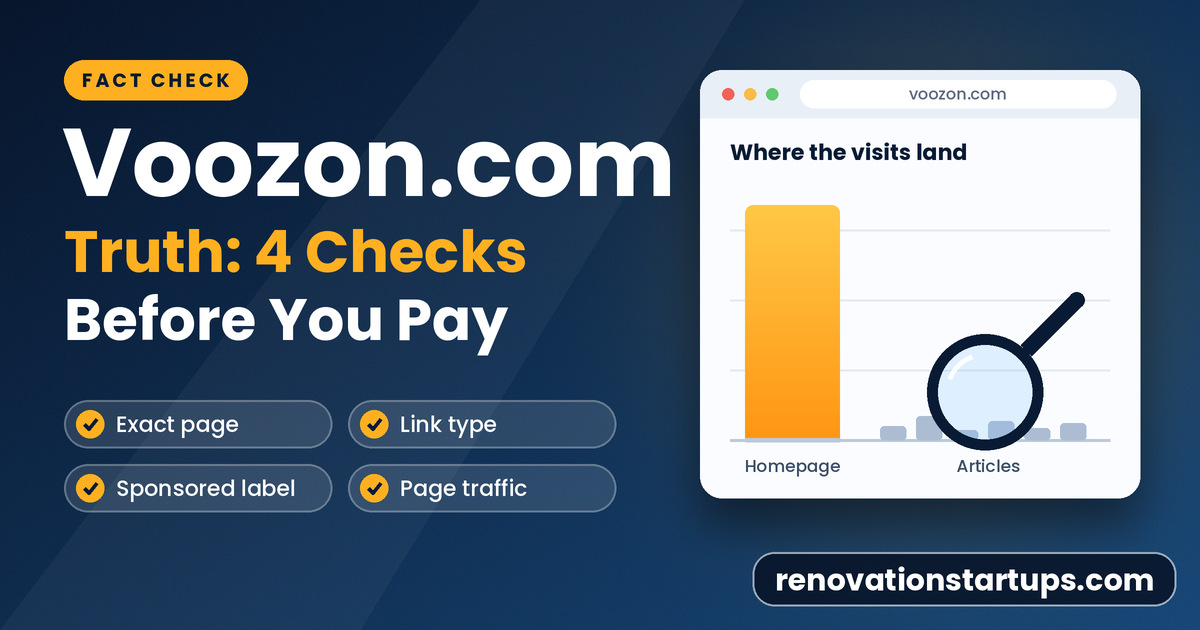
Voozon.com is a multi-niche blog that publishes articles on business, health, finance, travel and technology and openly accepts guest posts that carry links. It is a real and active website. Its owner is not named publicly. Its large traffic estimate comes almost entirely from people who already know its name. Reading it costs nothing. Paying for a placement there calls for checking the exact page first.
What Is Voozon.com and What Does It Publish?
The site calls itself a multi-niche blogging and guest-posting platform. Its own FAQ says submitted articles become public and can bring visibility and search benefits. That promise comes from the site itself. Nobody has verified it independently.
The homepage reads like a small online magazine. There is no login and no paywall. More than a dozen categories run from business and finance to automotive, home improvement, music, politics and sports. Older posts sit beside recent ones and the domain dates back to 2008. Quality varies. Some pieces give practical steps while others read as promotion for marketing tools and link services.
That range cuts both ways. Casual readers get variety while anyone wanting depth on one subject gets thin coverage. Bylines usually carry a first name only and no author credentials appear. Health or money articles deserve a second look at a source such as Health Canada or the Financial Consumer Agency of Canada before anyone acts on them.
How Much Traffic Does the Site Really Get?
One SEO tool estimates roughly 855,000 monthly organic visits. That sounds like a national newspaper. It is a modelled estimate rather than measured analytics.
When we lined up the estimate against the keyword list, two searches accounted for nearly all of it. About 738,000 monthly searches are for the full domain name and roughly 59,000 more are for the shorter brand name. These are navigational searches. Someone typing a site name into a search bar already knows the site and did not find Voozon.com through an article.
The homepage sits at the centre of the numbers. The same data credits it with all of the measurable United States traffic. No single article appears in the top pages report. About nine in ten estimated visits come from the United States, so a Canadian business chasing local readers gets little from the headline figure. The estimated advertising value is close to nothing because those brand searches attract almost no advertiser bidding. Page-level data from a comparable article would tell a buyer far more than any domain total.
Is the Site Legit and Safe to Visit?
It is a working site with HTTPS and public About, FAQ and Contact pages. Reading requires no account and no card details. Our search turned up no confirmed reports of malware or payment fraud.
Transparency is weaker. No company or editor is named. The contact page points to a free webmail address rather than one on the site’s own domain. The registrant details sit behind a privacy service. A long-registered domain suggests stability but says nothing about who runs the site today.
Automated reputation checkers disagree. One rates the domain likely safe because of its certificate and age. Another scores it much lower and cites suspected spam and blacklisting risks. Neither result proves wrongdoing. Treat the split as a reason for ordinary caution.
How Does Guest Posting on Voozon.com Work?
How to submit
There is no automated dashboard. The contact page invites guest post and backlink inquiries by email and says replies normally arrive within 24 to 48 hours.
What the site leaves unstated
The public pages show no fixed prices or word counts. They also omit editorial guidelines and link attributes. Refund terms and any promise about how long a post stays live are missing as well.
What to confirm before paying
Get these in writing:
- The exact article address and category.
- Whether the link is followed or nofollow.
- Whether the post is labelled as sponsored and stays live permanently.
- Traffic figures for comparable articles rather than the domain total.
Any quote in Canadian dollars comes from a seller and not from the site.
Are Its Backlinks Worth Paying For?
It depends on the page and not the domain. A link earns value when the article suits your field, gets indexed and reaches actual readers. Nobody can guarantee a ranking from a single placement.
Google Search Central treats links made mainly to manipulate rankings as link spam and advises marking paid links with rel=sponsored or rel=nofollow. Canadian guidance points the same way on labelling. The Competition Bureau enforces misleading marketing law. Ad Standards publishes guidelines asking for clear disclosure of paid relationships. Those guidelines were written for influencers, but the same principle can apply to sponsored articles.
How Do You Check a Placement After It Goes Live?
Is the page indexed?
Use the site: operator with the article address in Google. If nothing appears after a few weeks, the link is not doing much.
What do the link attributes say?
View the page source and look for rel=sponsored or rel=nofollow on your link. Confirm it matches what the seller promised.
Are real readers clicking?
Check referral sessions in your analytics. A placement that sends nothing after a couple of months tells you plenty. Recheck the page later to confirm it is still live.
Voozon.com vs a Niche Blog: Which Suits a Canadian Business?
A plumbing company linking from a plumbing blog reaches readers with wet basements. The same link inside a travel post reaches people planning a holiday. Broad sites widen general awareness but rarely deliver targeted visits. A niche blog usually reaches fewer people who care more. Relevance matters more to readers and to search engines than raw size. For referral traffic we would spread a modest budget across two or three topic-matched blogs rather than one broad placement. A business that only wants a general mention may still find a wide site acceptable if expectations stay realistic.
Why Do Other Pages Call Voozon a Shop or Software?
Search results mix several different things. There is the blog and there is a mobile app that shares the name. Some speculative articles also describe Voozon as an online store, a voice-chat tool or business software. Those descriptions do not match what the website shows. It has no product onboarding, subscription plans or dashboard. The app describes itself as a social platform for photos and messages. No ownership link to the site has been confirmed. Check the address carefully before entering personal details anywhere.
FAQ
Is Voozon a scam?
Nothing confirmed points to fraud. Missing ownership details and conflicting reputation scores still justify caution. Verify a seller’s identity and terms before paying anything.
Who owns Voozon.com?
The public pages do not say. No person or company is named. The registration details are hidden. Ask any seller for verifiable business details.
How much does a guest post on Voozon.com cost?
The site publishes no price list. Third-party sellers set their own prices and terms. Compare any offer against page-level results instead of domain figures.
Does Voozon.com accept guest posts?
Yes. The About and Contact pages invite guest post and backlink inquiries by email.
